The Forgiveness of Whales

Until recently, scientists thought humans were the only species with the specialty brain neurons responsible for higher cognitive functions like self-awareness, a sense of compassion and language.

They were wrong.Whale-and-Man-and-Forgiveness
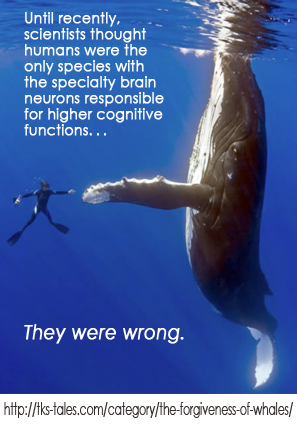
Fifteen million years before humans, whales began evolving these special cells*, and now a strange phenomenon is occurring off the Baja coast of Mexico.

Humans have been slaughtering Pacific whales there for a long time, first with harpoons, now with sonar from Navy ships. Whales live a long time, up to a hundred years. Some whales alive today still bear the scars of harpoons. Many scientists believe that it is implausible to think the whales do not remember this or associate humans with death and anguish.

Yet, in the same area where humans hunted them nearly to extinction, then tortured them with sonar, whales are approaching humans and initiating contact. A  N.Y. Times article detailed the experiences of the reporter and the stories of locals who tell about mother whales approaching their boats, sometimes swimming under it and lifting it, then setting it gently down. Almost all the stories involve the whale surfacing, rolling onto its side to watch the humans–reminiscent of the surreal moment in the movie, Cast Away, when a whale rises from the night sea to regard Tom Hanks with an eye cupped with starlight, an eerie intelligence, and a gentleness that moves us, for we know the massive creature could kill the castaway with a nudge or a flick of a tail fluke.

These real grey whales off Baja swim close enough that people invariably reach out to touch them, and they allow it. One person, reflecting on the experience said, “I have never felt more beheld.” It seems reasonable–given the position the whales place themselves in–that they seek the contact. In many cases, a mother whale will allow her calf to do the same. There is no food involved in these exchanges, only a brief interlude of inter-species contact and rudimentary communication:  I come as friend.

Why?

Where will humans be in another hundred years? I suspect we will be technologically advanced, but emotionally pretty much the same, even in a thousand years or ten thousand. But what about a million years? Can we evolve (if we survive) to a more sane, more rational, more loving species with a broader sense of our place in the universe and in life itself? Is it possible that these creatures with 15 million years of intelligent evolution on us, might regard us as a young species, children who don’t really know better,  and grant us leeway for our mistakes? Grant us . . . forgiveness?

If we humans could only do such a thing!  Beat our swords into ploughshares, at least among ourselves. It’s unlikely, but we might yet be targeted by alien invaders, so we shouldn’t throw away all of our weapons. Even whales have enemies, and they do not hesitate to defend themselves when attacked and even take the battle to the enemy! Recently, there are increasing reports of whales, specifically humpbacks, who are defending not only their own against attacks of orcas, but other mammals, such as other whales, sea lions, fur seals or walruses. They only attack mammal-eating killer whales, not orcas that primarily feed on fish. They feed and fight in a coordinated manner, communicating with each other.

There is proof that we humans are capable of realizing the power of peaceful cooperation and partnerships. Not long ago, for example, a team of over 2,000 scientists representing six countries worked to determine the human genome, all 3 billion parts, and then made that data freely available on the Web.

Perhaps one day we will stop slaughtering the fellow creatures on this blue-and-cream jewel that is our world; perhaps we will make friends and share discoveries, meeting whales on the mutual ground (or sea) of respect.

Our survival may depend on it.

*New research is indicating that glial cells may be responsible for imagination, creativity and probably play a role in consciousness. Einstein’s brain had an abundance of these cells, especially in the area responsible for spacial awareness and mathematics. Mice injected with human glial cells became 4x smarter. Glial cells can communicate with each other (via calcium waves) and with neurons, even signalling neurons to fire. Although whales don’t have all the “levels” of a human brain (and so their thought processes are probably distinctly different), whales have a much higher ratio of glial cells to neurons than humans in the neocortex, the area thought to be responsible for intelligence.
Resources:
http://blogs.scientificamerican.com/news-blog/are-whales-smarter-than-we-are/
http://scientificbrains.com/5-reaons-why-glial-cells-were-so-critical-to-human-intelligence/
http://blogs.scientificamerican.com/guest-blog/glia-the-new-frontier-in-brain-science/
http://www.scientificamerican.com/article/the-other-half-of-the-bra/
http://blogs.scientificamerican.com/brainwaves/know-your-neurons-what-is-the-ratio-of-glia-to-neurons-in-the-brain/
See below for other links.

black-divider-th

T.K. Thorne is a retired police captain (Birmingham, Alabama), director of City Action Partnership, and an award-winning author of fiction and non-fiction.

Other Related Links:
http://blueandgreentomorrow.com/2014/07/20/138000-species-under-threat-as-obama-approves-gas-and-oil-exploration/

http://www.takepart.com/article/2014/07/21/whales-and-dolphins-danger-obama-administration-approves-offshore-oil-exploration

http://www.salon.com/2014/07/18/choosing_big_oil_over_whales_obama_opens_east_coast_for_offshore_exploration/

http://animalperspectives.com/2014/07/20/oil-and-gas-exploration-on-the-eastern-seaboard-of-the-u-s-is-the-wrong-answer/

http://www.pressherald.com/2014/07/18/obama-opens-east-coast-to-oil-exploration-with-sonic-cannons/

http://www.nytimes.com/2014/07/19/us/white-house-opens-door-to-exploring-atlantic-for-oil.html?emc=edit_tnt_20140719&nlid=36553356&tntemail0=y&_r=1

http://news.msn.com/us/obama-opens-eastern-seaboard-to-oil-exploration

http://barnegat-manahawkin.patch.com/groups/politics-and-elections/p/court-rules-seismic-blasting-off-ocean-county-can-move-forward71876?ncid=newsltuspatc00000003#new_comment

Posted in The Forgiveness of Whales | Tagged , , , , , , | 12 Comments

Why Noah’s Wife Has Asperger’s

Noah’s wife has Asperger’s because walls and characters talk to me.

Talking wall:  Mural

I once organized the painting of a 140 foot mural on the side of the Police Administration building in downtown Birmingham, AL.  The mural design is a teenager’s winning interpretation of the Birmingham Pledge.   In the wall’s previous lifetime, it was attached to an adjoining structure.  When that section was ripped away, the repair left the outer wall smooth and white, pristine, a tabula rosa that shouted, “Paint me!” every time I walked by.  A radio station host blasted citywide that I was unstable because I heard walls talking.

In spite of this, the mural remains on the building, and it is my fervent hope that it speaks to other people every day.

Talking Characters: 

When I learned that the Bible gave only one brief mention of Noah’s wife, another tabula rosa opened before me. This unnamed woman had a story, a big story, and she was shouting “Write it!”  As I started to explore the possibilities, a scene formed in my mind of a young girl in an ancient culture speaking with her grandmother about the role of women.  As they talked (and I listened and typed), I realized Na’amah was special.  “My name means pleasant or beautiful,” she announced.  “I am not always pleasant, but I am beautiful.”  This girl saw the world in a different, literal way.  She spoke only truths because lying distressed her. I could see that this was going to get her into trouble in a culture that depended on the whims of the gods for survival.

I have had a long-time interest in autism, partly because it has affected my family and partly because it is a glimpse into the marvelous workings of our minds. In Noah’s Wife, Na’amah is an Asperger savant, a person with remarkable mental skills.  The term “Asperger Syndrome” was, of course, unknown in ancient times, but there is no reason to believe that the condition did not exist.  Most experts put it on the high-functioning end of the autism spectrum, although there is  disagreement about whether it should even be classified as a “disorder.”  Although every person on the spectrum is unique, persons with Asperger’s are usually highly intelligent. Some (about 10%) have extraordinary recall and obsessive knowledge about areas that capture their interest.  Na’amah’s passion was the sheep she tended on the hills of ancient Turkey. She preferred their company and her skills of observation gave her a deep knowledge and understanding of their behavior.

Why did I gave the central character Asperger’s?  The answer is multilayered.  Brain developmental disorders and particularly the phenomenon of savants have always intrigued me.  If it is possible for some brains to perceive the world differently and to have extraordinary skills, the potential must exist for all humans.  In fact, there have been experiments where scientists have used magnetic pulses to temporally “shut off” a portion of the brain (anterior temporal lobe) in non-autistic persons, resulting in the temporary production of savant abilities.  Fascinating stuff!

Also, I believe my own family has been affected by undiagnosed autism or Asperger’s. My uncle clearly had mental developmental issues and displayed several of the symptoms of Aspergers. Only after reading one of Dr. Temple Grandin’s books (as research for my novel) did it occur to me that my uncle might have a visual/audio processing issue as well.  All my life I thought he hated me because he would not look at me or respond to me at all. After reading Grandin’s Animals in Translation, I visited my uncle in the hospital (dreading it) and asked him a question, knowing he would not answer me, but this time, as an experiment, I waited and didn’t say anything and, after what seemed a long while, he looked at me and responded as if we were having a normal conversation. It was quite a moment, and we were able to converse until he died some months later.

For my novel, I wanted to have a character who did not automatically accept all the precepts of her culture, but I had no conscious intention of giving her any kind of syndrome. As I wrote Noah’s Wife, however, the character of Na’amah began to take on a life of her own (one of the joys of writing).  She surprised me with her unique perspectives, her obsession with sheep, her propensity to be literal and, by the end of the first chapter, I realized that she had Asperger’s. To be honest, I struggled with this for a while, but in the end, I conceded that it was more important to let Na’amah be who she wanted to be than to put her in the box of who I thought she should be.

I was in for an interesting journey with this story, a unique twist on the Biblical account based on evidence of a great Black Sea flood 6.5 thousand years ago, and I wanted to see what Na’amah would do and say and where she would take me.  She often surprised me with her observations, the depth of her spirit, and how what seemed her handicaps became strengths.  When the book was finished (four years later) I missed her.

Yes, my characters tell me things I don’t know, and walls talk to me.  I admit it.

Aren’t I fortunate?

black-divider-th

T.K. Thorne is a retired police captain (Birmingham, Alabama), director of City Action Partnership, and an award-winning author of fiction and non-fiction.

Noah’s Wife & The Titantic:              About the Book             More Behind the Scenes Info

NOAH'S WIFE COVER for AUDIBLE for web

Click image for audio sample and special offer info

Titanic

Posted in Why Noah's Wife Had Asperger's | Tagged , , , , , , , , , , , , , | 6 Comments