I very rarely do this, but today—with her generous permission—I am posting a piece by my cousin, Alice Hart Wertham, that I found moving and meaningful and think you might too, regardless of your relationship with the concept of the divine. It might change how you see time.
Alice read this in her synagogue in celebration of her 75th birthday. The first paragraph is the weekly Torah (Bible) portion. The same lines are read every week in synagogues all over the world. The rest is her d’var Torah, a short offering of insight, interpretation, or life lesson based on that reading.
Time
A Reflection on My 75th Birthday
“The Lord spoke to Moses, saying: Speak to the Israelite people and say to them: These are My appointed times, the sacred occasions, which you shall proclaim at their appointed times… Six days shall work be done, but on the seventh day there shall be a Sabbath of complete rest, a sacred occasion.”
Leviticus 23:1–3
As I prepared to read the Torah on the occasion of my seventy-fifth birthday, I found it ironic that the passage begins with these opening verses of Leviticus. Before the Torah tells us about our major holidays, it begins with Shabbat. Before it speaks of sacred places, it speaks of sacred time.
Ironic, because I have always been fascinated by time.
Birthdays make us count the years we have lived, the people we have loved, those we have buried, the children who have become adults, and now the grandchildren who are creating memories of their own. And yet, I have come to believe that measured time—the time of clocks and calendars—is not time itself. It is simply how we human beings live our daily lives.
Eternal time is different.
God, the One, the Indivisible, the Infinite Majesty, inhabits eternity—not endless years stretched into infinity, but something beyond our comprehension, where yesterday, today, and tomorrow exist together. There is no counting for God.
We humans, however, live one day at a time. The future is concealed from us, not to frustrate us, but to give us something extraordinary: the freedom to choose. Measured time is the arena of free will, where we grapple with the uncertainty and chaos of life. Every morning arrives anew. Every conversation presents a choice. Every disappointment asks who I will become because of it. Every joy invites gratitude rather than possession. And every wrong we have done offers the possibility of teshuvah—of turning back, making amends, and beginning again.
Looking back over seventy-five years, I remember not years, but moments.
Abraham Joshua Heschel taught that Judaism is a religion of time more than space, teaching us to sanctify time and find the holy in the mundane. I understand that now, in a way I could not when I was younger. The most sacred moments of my life have been connected to time: standing under the chuppah with Brian, and later under the chuppah with each of our three children; bringing food to a mourner or a sick friend; sitting beside my parents as they left this earthly life; holding my newborn children and recognizing that they were not mine to possess, but entrusted to me to raise and release; cherishing friendships deepened over decades simply by being present; experiencing the grandeur of the natural world; and even ordinary Tuesdays that somehow became unforgettable.
Life has always been built out of moments.
Shabbat has become more precious with age. It reminds me that I am more than what I accomplish. The world measures our lives by productivity; Shabbat invites us to measure them by presence. It asks us to stop, notice, bless, and remember—a brief period when eternity touches measured time.
And then there is Sukkot. For seven days, we leave the security of our homes and enter a fragile, temporary structure. We are reminded that what feels permanent is not permanent at all.
When I was younger, permanence seemed natural. There was always another decade ahead, another opportunity, another chapter. Now I am more conscious that everything we build is temporary. Our homes, possessions, careers, even our families and our bodies are sukkot of a kind—structures in which we are privileged to dwell for a while. Yet we fill the sukkah with food, stories, laughter, and gratitude. Knowing it will come down does not make the celebration less meaningful. It makes us more present for it.
Sukkot is Z’man Simchateinu—the season of our joy. Impermanence does not diminish the value of life; it intensifies it. I cannot know how many years remain, but I can choose to dwell more fully in the ones I have been given.
A moment does not have to last forever to matter forever. A conversation can change a relationship. Holding a grandchild’s hand can last only a moment and remain in memory for a lifetime. A Shabbat dinner ends, a sukkah comes down, a birthday passes—but the love experienced within those moments becomes part of who we are.
Because life is finite, kindness and forgiveness matter now. Love should not wait for another day. We cannot relive yesterday, but through teshuvah we can choose today with greater compassion, humility, and love.
Earthly, measured time is where we encounter God, exercise free will, and become the people we were created to be. Shabbat gives us a glimpse of eternal time, teaching us to find moments of Shabbat even within our ordinary days.
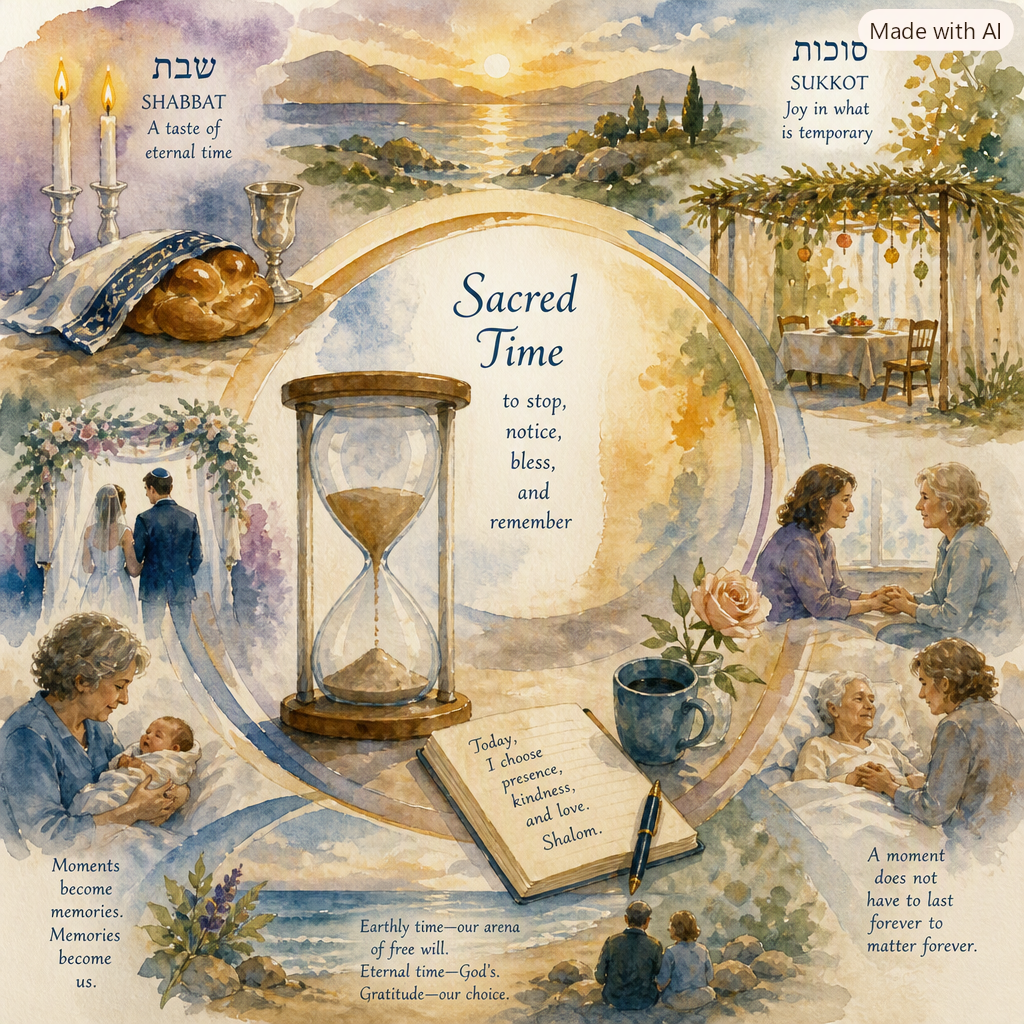
As I celebrate this birthday, I am profoundly grateful—not simply for seventy-five years, but for seventy-five years filled with moments, all woven together into a life I could never have imagined when it began.

T.K. Thorne is a retired police captain (Birmingham, Alabama), former director of City Action Partnership, and an award-winning author of fiction and non-fiction.
I write about whatever sparks my curiosity — the things that make me pause, wonder, or mutter “well, that’s interesting…”.
While you’re here, feel free to look around my website and my books (I write across genres, so there’s likely something you didn’t expect).
If you arrived by way of my blog on Substack, here’s your breadcrumb trail home.
If you slipped in through The Stiletto Gang, here’s the door you came through.
Discover more from T. K. THORNE
Subscribe to get the latest posts sent to your email.


