It was a headline. It was subtle and chilling, and I couldn’t help wondering if I was complicit.
In 2021, a book I’d labored on for eight years came out. Someone recently referred to it as an “alternative history.” Those words chilled me, too.
Let me back up. A few weeks ago, the National Park Service for the Highway 80 National Memorial held an educational symposium in Selma, Alabama. I’d agreed to speak on a panel about findings from my book. A few days before the event, the park ranger notified me that the event funding had not been approved in Washington, D.C. (a new requirement). It was no mystery why that happened.
The Highway 80 Memorial preserves the history of the Selma to Montgomery March in 1965, where protestors wanting the freedom to register and vote attempted to march across a bridge in Selma. In front of news cameras and reporters, state troopers and a local posse beat them. The shock and horror of what America saw helped pass the Civil Rights Voting Act of 1965.
Despite the lack of funding, I attended the symposium, as did other panelists.
The talk was well-received, and I learned a lot from the other panelists. Quite worth the trip, even without the honorarium. I considered it a donation to the National Park Service.
The National Park Service website, “What was the Underground Railroad?” had been modified. The first line of the original webpage was “The Underground Railroad — the resistance to enslavement through escape and flight through the end of the Civil War — refers to the efforts of enslaved African Americans to gain their freedom by escaping bondage.”
It was changed (grammar issues aside) to: “The Underground Railroad—flourished from the end of the 18th century to the end of the Civil War, was one of the most significant expressions of the American civil rights movement during its evolution over more than three centuries.”
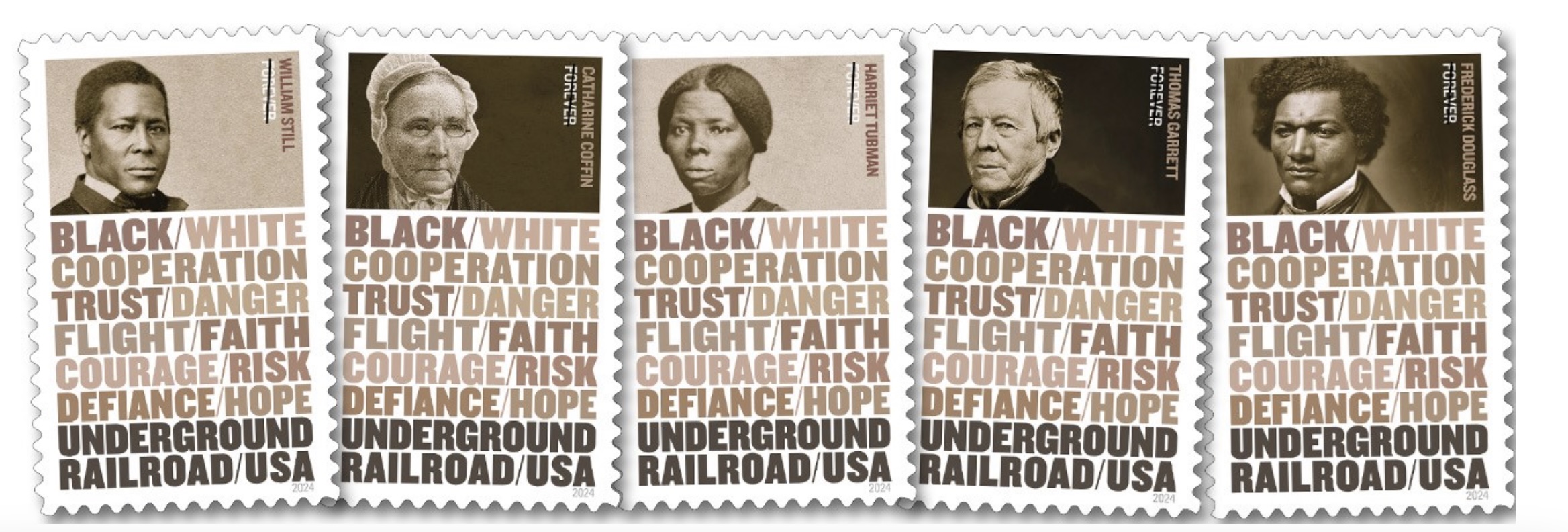
Photographs of vintage stamps of five abolitionists, two of whom are White, replaced the central figure of Harriet Tubman.
Don’t get me wrong. I think it is important and helpful to understand and recognize that non-Black people played a role in civil rights, as long it does not occlude or diminish the harsh truths of slavery and Jim Crow and the struggles of the people who endured them.
My book, Behind the Magic Curtain, was about unveiling the forgotten stories of White allies that existed alongside the civil rights movement. It was meant not as an “alternate” history but as an enrichment of our understanding of what happened. If I may quote myself:
“Standing up matters, and stories matter. Both show us what is possible, even in times of darkness.”
Although the photos that replaced Harriet Tubman’s did include her, other than the tiny inscription on the stamp, there was now no mention of her on the entire page.
Screenshot
Harriet Tubman was known as the “conductor” and “Moses” of the Underground Railroad. An escaped slave herself, severely injured in childhood by an irate “master,” she repeatedly risked her life by returning to the South, personally rescuing up to seventy enslaved Black people and guiding them to freedom through forests and swamps. Her amazing and inspiring story is linked unalterably to the Underground Railroad.
Or maybe not. . . .
History has as many truths as there are perspectives. I’m a writer. I get that. But I am from Alabama. I was in my forties before I ever heard of Harriet Tubman. Shame on me. But shame, also, on the educational system that taught me slaves were “happy on the plantations.”
A Park Service employee told The Washington Post that “staff members received only vague guidance and that the selections were made amid a ‘frenzy of fear,’ at a time when thousands of federal workers were losing their jobs.”
I do know that is not the way to write—or rewrite—history.
P.S. Like the previous removal of the Tuskegee Airmen and Women Airforce Service Pilots (WASPS) from the U.S Airforce training materials, the Underground Railroad web page (and Harriet Tubman’s picture) has been restored to its original state after protests. The National Park Service said the changes were made without their leaderships’ approval. The national parks and history, for that matter, belong to all of us. Our voices can make a difference.
Wow! This is something that doesn’t happen every day!
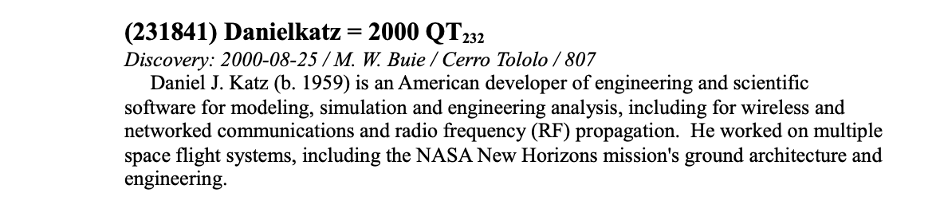
My brother just had a “small planet” (asteroid) named after him! (I know I’m not supposed to overuse exclamation points, but I can’t help it.)
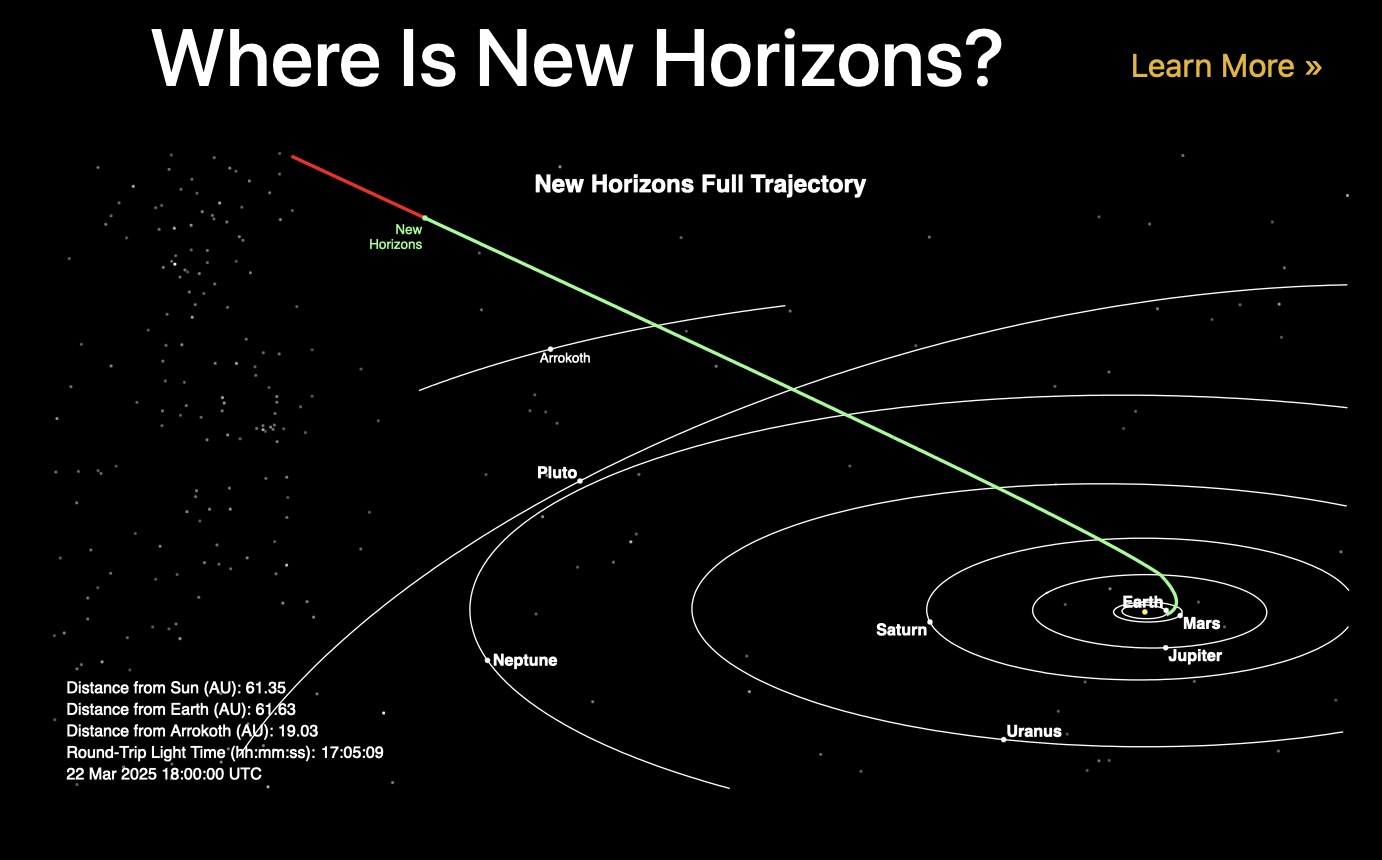
He earned this honor through his work on the New Horizons project—a NASA mission to study the dwarf planet Pluto, its moons, and other objects in the Kuiper Belt.
I am thrilled to announce [drum roll, please] the minor planet: Danielkatz!
I have a special appreciation of Pluto because many years ago, my first published short story (a big deal for a writer) was about an astronaut who crashed on Pluto. Here is a snippet from “Chrysalis.”
Eternity is subjective. I’m spending mine clawing into nitrogen-methane snow and dragging my body by painful centimeters from the ship’s wreckage. My helmet monitor lists internal bleeding, spinal injury, and two fractured ribs. Legs don’t work. Breathing hurts. Easier to just let the cold take me or for a piece of the ship to fall on my head and end it, but I’m a stubborn woman, as my father would attest . . . were he not three billion miles away.
Shallow gasps fracture the profound silence inside my helmet as I crawl through twisted metal toward the faint light, hoping the suit won’t tear on anything before I have a chance to see the stars again. Beneath me, the ground trembles. Is Pluto trying to live up to his ancient title as god of the underworld?
Over the years, I’ve been obsessed with making sure I got the science in the story right. I sent it to Pluto expert, Marc Buie, who was kind and generous enough to read it and answer my questions. New revelations about the dwarf planet have been fast-incoming. They’ve included data and speculation from the New Horizons’ mission, which is still ongoing, long past it’s expected lifespan. The little-probe-that-could is now far beyond Pluto but still sending data about the Kuiper Belt, where giant asteroids that qualify as “small planets” orbit our sun!
Screenshot
Whoops, there I go with the exclamation points again. Can you handle one more?
Now, I need to put the small planet, Danielkatz, in a story!
I write about what moves me, following a flight path of curiosity, reflection, and imagination.
Feel free to explore my website, but if you arrived by way of my blog on Substack, here’s the way back.
If you arrived by way of “The Stiletto Gang,” a fun daily blog by mystery authors, here is your ticket there.
How Concerned White Citizens Marched in Selma Before Bloody Sunday
Warning: This is a speech I gave recently in Selma at the “Highway 80 History Symposium” It’s longer than I normally post, but I believe it is timely.The content is based on a portion of research from my nonfiction book Behind the Magic Curtain: Secrets, Spies, and Unsung Allies of Birmingham’s Civil Rights Days.
A small thing made all of human civilization possible. It is often overlooked and undervalued, but it is so much a part of our lives that we don’t pay much attention to it. We did it even before we developed language, and we still do it. It is a deep part of who we are as a species, and it is so powerful that it can change everything.
What is it? What made human civilization possible?
We tell stories. Stories did and do more than convey information; they instilled the values that kept communities together and built civilization.
In Israel, when the Holocaust Memorial organization finds stories about non-Jewish people risking their lives to save Jews, they honor the person by naming them “Righteous Among the Nations.” The fact that those people were exceptions among a majority who did nothing to help or even were complicit in the atrocities only underscores the risks they took and their courage. It is important to honor and remember them and their deeds.
History bears witness to terrible injustices in the name of one group claiming superiority over another, a pattern repeated throughout our species’ story. It is a sad fact that America’s example of racial discrimination reinforced Adolf Hitler’s ideas about the superiority of what he called the “Master Race.” But it is also a fact that stories about the peaceful, brave resistance to racism and Jim Crow here provided courage and inspiration to the world.
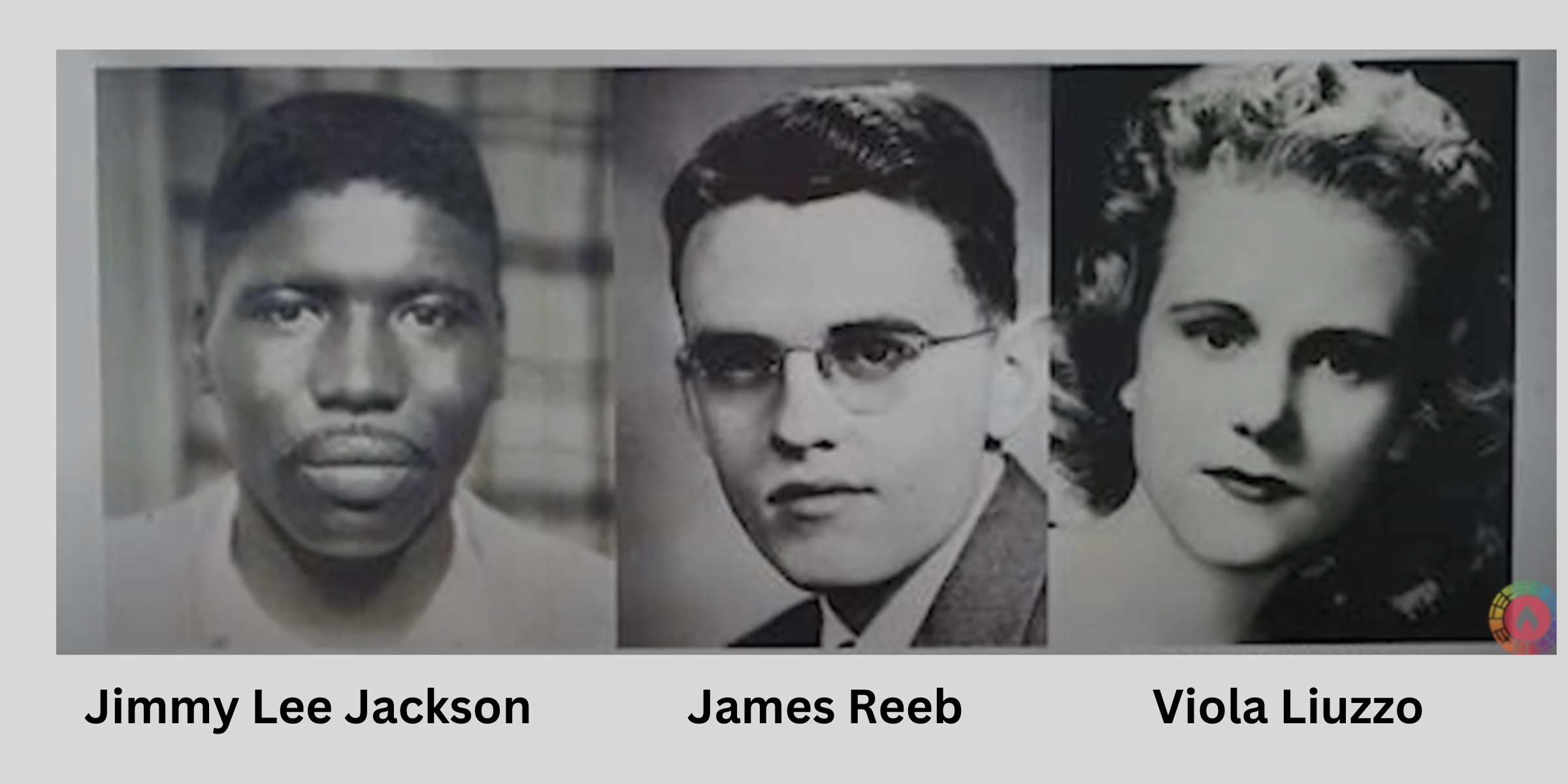
We are familiar with the stories of the struggles for voting rights in the South, particularly the Black Belt. We know that Jimmie Lee Jackson, a young black man, was shot and killed when he attempted to defend his mother against a beating by a law enforcement officer. We know his death inspired the Selma marches. We know about the cruelty of Bloody Sunday, the batons and tear gas, and the political maneuvering that finally allowed the march to Montgomery.
We know that Reverend James Reeb, a White Unitarian minister from Boston, and Viola Gregg Liuzzo, a White woman from Detroit, were also murdered for their participation in the marches and that White people from across the country came to join Martin Luther King and John Lewis to make that symbolic trek to the state capital.
But a story got lost in the shadows cast by those portentous days, a story we need to hear and remember.
It began in Birmingham, Alabama, where a small group of Black and White people, the Council on Human Relations, had been meeting since the 1950s, despite Jim Crow laws that forbid them to do so. They met in the Black First Congregational Church, which welcomed them. The women made a point to socialize in each other’s homes and to get to know one another as friends. By 1964, they would name their group “Friends and Action” and take on projects in the community. They offered classes for Black students, started an integrated Head Start playground, sent mixed groups of youths to experiences out of state, obtained lab equipment for Miles College, and invited speakers to the Unitarian Church.
Two of the White women, disturbed by the events in the Black Belt, made a trip to Selma to “see for themselves” how the Dallas County Sheriff’ Jim Clark’s department was suppressing Black voter registration and terrifying the Black community. They returned to report what they had seen.
The group requested one of the activists come to talk to them. Hosea Williams came to Birmingham and told them about the cruelties imposed on Blacks who registered to vote or attempted to and about Jackson’s murder.
Distressed, one White woman asked, “What can we do to help?”
Williams replied, “I’ll tell you one thing you can do to help. You can take some warm, white bodies down there and show you care.”
Divided about what to do and fearful of taking such risks, the group argued. But one woman stood up and said she was “tired of having Black people do all the work. I don’t care if anyone else goes to Selma. I’m going if I have to go alone.” One of the women who had gone to Selma to see for herself, joined her. Their determination moved others.
Led by the Reverend Joseph Ellwanger of St. Paul’s Lutheran Church, the group made phone calls and sent delegations to other Whites throughout Alabama to rally in Selma with a march to the courthouse. Brief newspaper coverage brought in warm letters and contributions from across the country.
With only ten days’ notice, seventy-two White people—forty-six from Birmingham—answered the call. They were Christians and Jews from across the state. When the group arrived in Selma, they were welcomed at the Reformed Presbyterian Church by the SCLC’s James Bevel and Father Maurice Ouellet, who, like Ellwanger, served a Black congregation. One recalled that “quite a few Blacks were there. They were so happy and so astonished. They were just not used to having Whites come on their side.”
Another White protestor, speaking unknowingly to a New York Times reporter, said, “‘We have remained silent for a long time, trying to give moral support to Negroes. I felt it was time to show that a group of demonstrators can have a face other than that of the Negro.”
From Broad Street, the group marched two by two with signs reading, “Silence Is No Longer Golden” and “Decent Alabamians Detest Police Brutality.”
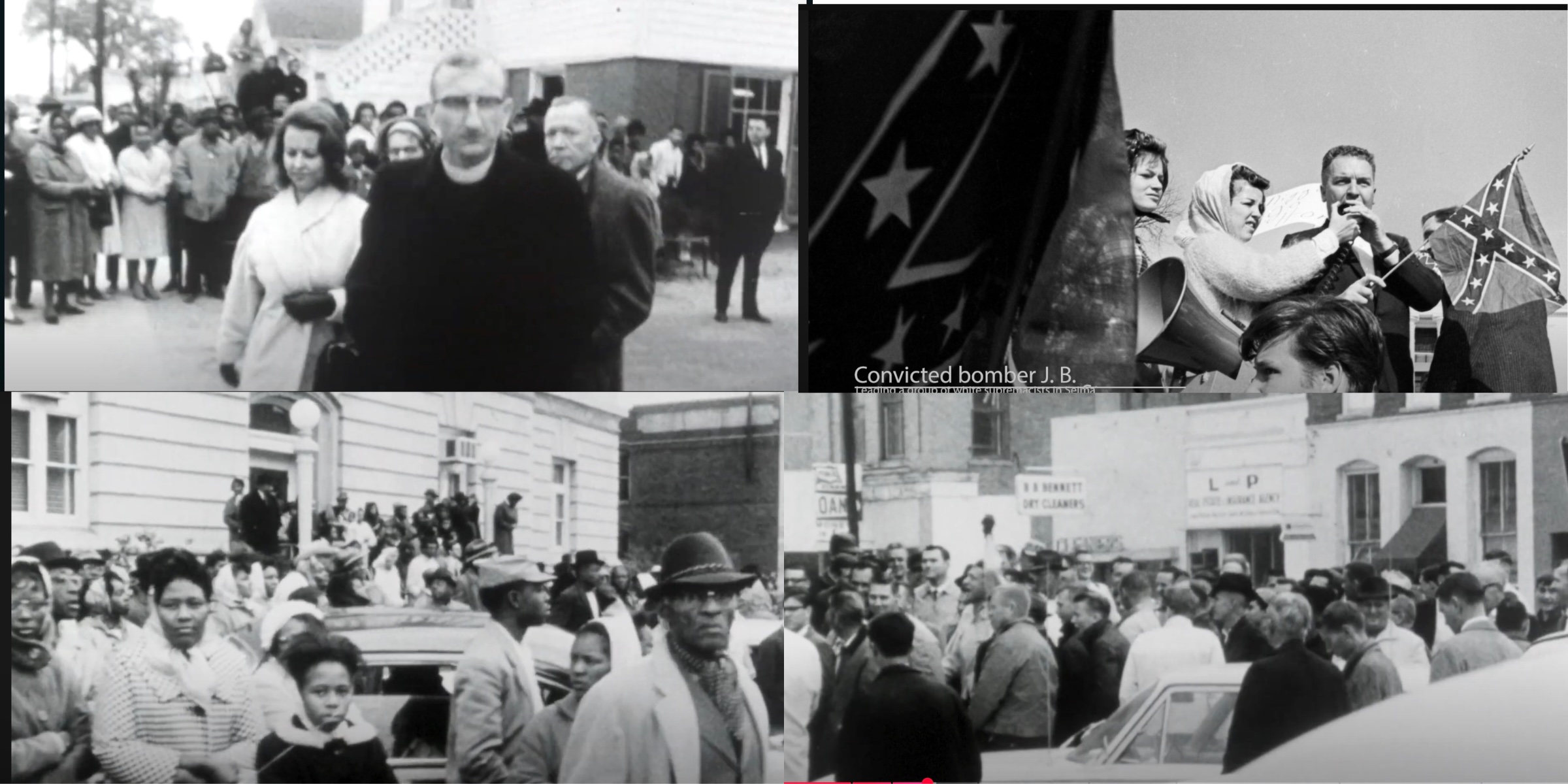
At Alabama Street, Rev. Ellwanger, who led the group, recalled, “…on our right were about a hundred white men . . . with baseball bats or pipes and using foul language to let us know what they thought of us. To our left, on the far side of the intersection, in the street, and on the grassy area around the federal building were about four hundred blacks shouting words of encouragement.”
Image courtesy of Bending the Arc film, VOTE! at www.youtube.com
Members of SNCC, the Students Nonviolent Coordinating Committee, who had been working for voting rights in Selma, advised the White marchers, who did not have a permit, to follow the law by walking in pairs a few feet apart, and to ignore the taunts, shouting, and spitting. Dressed in their Sunday best, the marchers walked on. They were prepared to be arrested, but that was not their purpose.
One of the women recalled, “You could feel the danger in the air, the hatred. We had to keep our faces straight ahead. We were just there to let people know that there were white people in Alabama who believed blacks should have equal rights. ”
Amelia Boynton, a longtime activist in the Dallas County Voters, was among the Blacks watching. “I can never do justice,” she later said, “to the great feeling of amazement and encouragement I felt when, perhaps for the first time in American history, white citizens of a Southern state banded together to come to Selma and show their indignation about the injustices against African Americans. . . . They had everything to lose, while we . . . had nothing to lose and everything to gain.”
Past the jeering mob, Ellwanger led his group to the courthouse steps, where he read their proclamation protesting the treatment of arrested Negroes in keeping them from voting and gathering in lawful assembly.
When he finished, seventy-two voices lifted in “America the Beautiful.”
The hostile mob tried to drown them out with “Dixie.”
But from across the street, the hundreds of Black witnesses joined in with their strong voices to finish “America the Beautiful” and sing together, “We Shall Overcome.”
After Reverend Ellwanger read their proclamation, they were able to get back to their vehicles—by dent of luck and the fact that Sheriff Jim Clark was not in town—and shake the pursuit of two carloads of Klansmen.
But there were consequences. Those involved in the marches were subjected to harassing and threatening calls, and at least one man encountered a cross burning in his yard and a mob’s demand to leave town. Money had to be raised for guards around Rev. Ellwanger’s church and residence. One woman’s car was pushed over an embankment, and she lost her job at a suburban newspaper. A businessman discovered all the windows at his wholesale furniture business broken. His customers received anonymous warnings that if they bought furniture from him, they would find broken windows at their own companies. Overnight, he lost his business. If the Klansmen chasing their cars had caught up with them, the cost of their stand might have been much steeper.
The lesson from this remembrance of the “Righteous Among Alabamians” is that standing up matters and stories matter. Both show us what is possible, even in times of darkness, feeding the embers of hope into the fires of courage. History bears witness to terrible injustices in the name of some claiming superiority to others. But we also have the capacity to see ourselves in each other and work toward a world that reflects that. Hearing and understanding history’s stories helps us perceive and understand our choices. Our future depends on which paths we take.
I write about what moves me, following a flight path of curiosity, reflection, and imagination.
Feel free to explore my website, but if you arrived by way of my blog on Substack, here’s the way back.
If you arrived by way of the “The Stiletto Gang,” a fun daily blog by mystery authors, here is your ticket there.
This is the time of year to wish peace on Earth, a goal and prayer that seems always before us, and “When will we ever learn?” echoes in our minds.
But what if you had a magical chance to change things….?
If you woke to find a genie sitting on the edge of your bed, willing to grant you three wishes, what would they be?
I pondered this question many years ago and was recently asked it again in an interview. As a child, my answer was always simple and the same: I’d wish for a horse.
As I grew older and more sophisticated, I started appreciating the entanglement of the question: What kind of horse? Do I need to use my remaining two wishes for funds to maintain the horse and keep it healthy? How much do I wish for? What if someone I loved got sick, and I had to use a wish to make them well?
In fairy tales, I noted that the first two wishes, though well-intentioned, got the protagonist into hot water of some sort, and the third wish invariably had to be spent rectifying the situation. Very poor decision-making, in my opinion. The same is true in writing, a decision by the characters often takes the story in another direction entirely.
I pondered the problem (because you never know when you might find a genie on the edge of your bed, right?) When the solution came, I was very relieved. I had the answer. I was prepared. The resolution was beautiful in its simplicity and legal soundness: My first wish would be—to be granted three more wishes whenever I used up the other two! Clever, right?
As an adult, I realized that the real lesson of fairy tales was not how to use one’s wishes wisely, but that there are always unintended consequences.
Creating more food with less work and loss is a worthy goal, and we have accomplished it. It came about through the use of pesticides that, indeed, resulted in fewer insects, but also killed off the beneficial insects along with the pests and introduced sneaky carcinogens into our food chain that, in turn, raised health care costs and cut short the lives that “more food” was supposed to support.
China tried to control its population growth with a one-child limit, which resulted in a significant reduction of female babies (which were seen as less desirable than male children), and now, the country has negative population growth and a problem with too few women available for marriages.
In New Zealand, rabbits were introduced and became a problem, so they brought in stouts (a type of weasel) to eat the rabbits. However, now, the stouts are a threat to the bird population.
In the American South, we are “blessed” with kudzu, a prolific Asian vine imported for cattle grazing. Unfortunately, cattle don’t like it. It will eventually consume the world.
Even wishing for “peace on Earth” could have unintended horrific consequences. Rome’s centuries of peace (Pax Romana) came with a price in blood. Hitler wanted a reign of peace. He just needed to conquer a few countries and wipe out a few peoples first.
This is one of the problems we would/will face if Artificial Intelligence (AI) were tasked with such a goal and could make real-world changes. Imagine what lengths it would go to ensure “peace!” We might be stripped of the ability to speak freely or even interact or force-fed the “blue pills” [The Matrix] to remain in contented ignorance. Freedom and safety have always been a matter of delicate balance and unintended consequences.
It can be overwhelming. But, as ancient sages have said:
“Do not be daunted by the enormity of the world’s grief. Do justly, now. Love mercy, now. You are not obligated to complete the work, But neither are you free to abandon it.“
So, yes, we must work for peace, and I will gladly spend a wish on it, but perhaps it should include a well-thought-out document with a team of lawyers, futurists, and philosophers! Even then, hang on, because we know what happens to the best-laid plans of mice and men….
Happy Holidays to All!
P.S. You are warmly invited to explore my website, but in case you arrived here by way of Substack and would like to return, feel free to jump back through THIS PORTAL.
I just read an article about the importance of connecting or reconnecting with our playful selves. “It offers a reprieve from the chaos.”
That sounded intriguing. There is certainly a lot of chaos going on at the moment. I could use a reprieve.
When we were children, we didn’t play to accomplish anything. We just played. Explored. Play = fun. Fun was an end goal. We didn’t post stuff we did to social media or analyze what we learned.
We just played. Learning was the byproduct of curiosity.
If I may borrow a biblical phrase—And it was good.
But who knew there were personality play traits?
One study broke preferences down into four categories:
other-directed (enjoy playing with others),
lighthearted (nothing too serious, please; let’s improvise!),
intellectual (ideas, thoughts, wordplay, and problem-solving), and
whimsical (doing odd or unusual things in everyday life).
Our play as adults adapted from what we naturally enjoyed (our play preference) as children. Some adults, for example, “seek fun through novelty, whether it’s traveling to new places, exploring new hobbies, or buying new gadgets.”
“List the activities you enjoyed as a kid,” the article suggested, “then brainstorm the grown-up version.”
So, here goes:
I liked to climb trees. I had a special tree in the front yard, a young live oak with inviting arms that was my special place to go when things got tough, or I wanted a different perspective, or a steady, quiet friend. There was also the top shelf in the tiny linen closet that had an antique oval glass window where I could look out at the world, but no one could see me.
I rode many amazing chimera horses that were my legs, jumping over logs, chairs, bushes, and anything in my path. And if there weren’t enough things in my path, I would put them there to jump over. (Would you believe that is a sports competition now with adult people? It’s called “hobby horsing!” ) I currently have three real horses in my yard, but they think they are living at the Horse Retirement Riviera, and I doubt “jumping” anything is on their play list.
I did have a Barbie doll, but she was in reality a prop for my plastic Breyer horses. To my annoyance, she could only ride sidesaddle with her legs sticking out straight. I draped my horses in my mother’s costume jewelry and had them interact in elaborate storylines, often without the interference of people characters. Who needed them?
Screenshot
Lest you think me a hermit, in the first decade of my life, I did interact with others in play. I remember games of Red Rosie, tag, touch football and kickball, but when we didn’t have enough people for that or were too young to join in, I participated in impromptu gatherings where we acted out scenarios. I was usually the bossy “director.”
“You are the prince. And you are the princess. And you are the merchant. And you are secretly in love with the queen and, oh yeah, I am the queen….”
Hmm.
At least in part, intellectual play seems to have appealed to me. That sparked this idea:
Maybe I need to look at writing, not as a chore TO DO, but as a chance to play.
I like that.
So, hang on. We’re just playing here.
When I write, I often use two of the most powerful words that I know of. They open doors into imagination, exploration, and . . . play.
They are (cue drum roll)—
“What if . . . ?”
What if I were a rookie police detective . . . and a witch?*
What if Noah’s wife was an amazing young girl on the spectrum?*
What if the story of the church bombing that killed four young girls was told by the investigators who chased down the evidence and pieced it together to bring justice decades later?*
What if a young desert girl posing as a boy was able to travel with her caravan merchant father and had a little problem with obedience?*
What if the story about civil rights in Birmingham was far more nuanced and complex than anyone realized?*
What if a young musical genius has an alien BFF?*
What if I just thought I was a serious writer, but I am actually just playing?
[Laugh of delight!]
How did you play? Is there a way to replicate that now, to permit yourself to do something just for the joy of it?
*The results of my adult play:
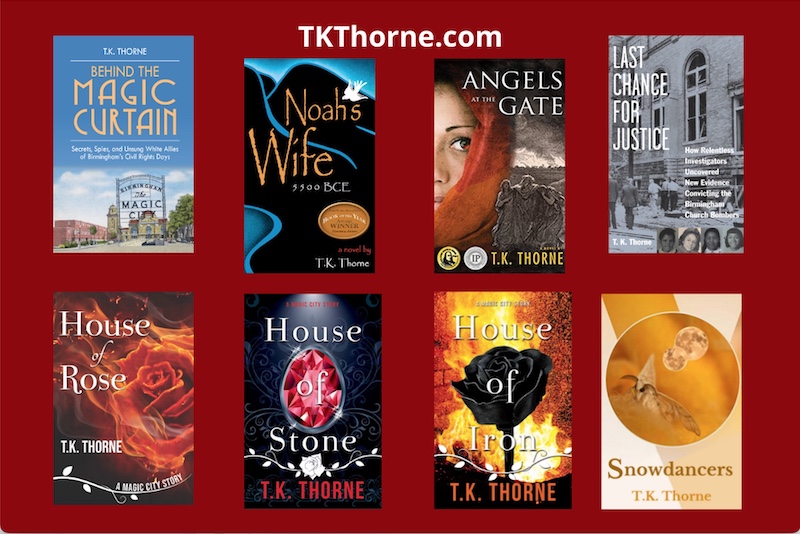
House of Rose/House of Stone/House of Iron
Noah’s Wife
Last Chance for Justice
Angels at the Gate
Behind the Magic Curtain: Secrets, Spies, and Unsung White Allies of Birmingham’s Civil Rights Days
Snow Dancers
I write about what moves me, following a flight path of curiosity, reflection, and imagination. Check out my (fiction and nonfiction) books at TKThorne.com
Our grandchildren, or those who were very young during it, might forget all about it by the time they are grown, as most of my generation has little knowledge of the 1918 flu pandemic and the fact that President Woodrow Wilson tried to suppress news of the devastation because he thought it might lower morale during war time (WWI). Spain, being neutral in the war, reported their cases, hence, the pandemic was misleadingly dubbed the “Spanish” flu.
Screenshot
We, who lived (and are living) through Covid, have memories of the terrible stress of those early months—watching freezer trucks lined up in NYC to hold bodies, disinfecting our groceries, not being able to see or touch a newborn grandchild or elderly loved ones, and dealing with the seclusion of our home santuaries/prisons. Grocery stores had a strict limit on how many people could be in the store at a time. We tried to stay six feet away from other humans. Those who worked from home had to learn new technology and simultaneously deal with children who would normally be at day care or in school. People were dying by the thousands; jobs and housing were often hanging by a thread. It felt like the end of the world.
I dealt with the stress by learning to swing a mattock (a pick/hoe combo tool) and attacking the wisteria invasion in my back yard, then pulling tiny plants from the moss along my brick walkway, rescuing two horses, and creating a small pond in my yard. I learned Tai Chi from Internet videos, started watercolor painting, and growing vegetables with my flowers. Fortunately, I was working on a non-fiction writing project (Behind the Magic Curtain: Secrets, Spies, and Unsung White Allies of Birmingham’s Civil Rights Days) and had a lot of research and editing to do—because my creative writing muse was on ice.
During the hay days of Covid, people relished the opportunity to get outside, to breath the healing air exhaled by forest or gardens. Passing someone on a path or sidewalk (even at a distance), we felt an instant connection, happy to see a person of any sort, perhaps the same way those who live in isolated villages throughout the world have always eagerly welcomed visitors.
Friends who live on their boat in the Caribbean during non-hurricane months told us that during Covid, they were “stuck” near a small island with five other boaters with whom they developed close relationships. The island was closed, but the owner of a small restaurant on land snuck them groceries and took in laundry.
My cousins in the suburbs north of Atlanta began gathering weekly in someone’s yard with their neighbors for a drink and conversation, a ritual they continue.
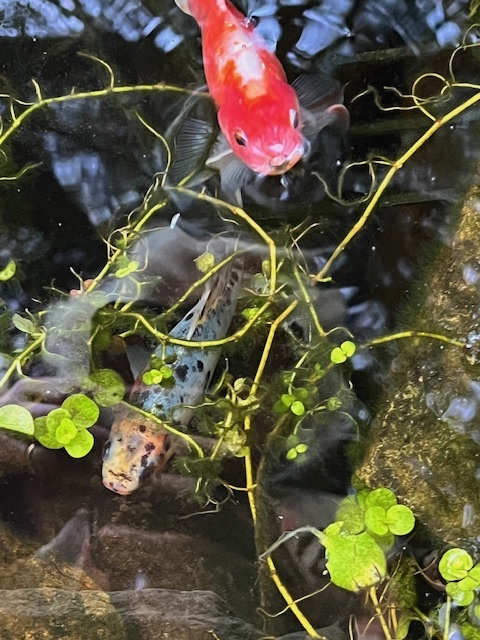
Today, tending my garden (and two fish—meet “Blue” and “Golda Meir”) and horses, practicing martial arts, and painting give me joy and peace. I look at the land around us with a different eye, thinking about whether and how we could supplement our food if needed. My writing Muse woke up after throwing water in her face and shaking her, and I finished a new novel.
The changes are internal and external. The downtown of our nearest major city has transmuted. More people live there; less people work there. Working from home has left commercial buildings across the country empty but given millions of people options about where they live and how they work. We are still adjusting. I hope we are also remembering.
Remembering that people are precious, regardless of their politics.
Remembering that nature is precious and powerful.
Remembering that we can adjust; we can change; we can meet challenges.
Today, despite all the scary stuff going on, I have more faith that people will adjust. What a strange gift from a pandemic. If you think about it, nature regularly reminds us what we are capable of.
“Dear Autumn . . . [You are] a Master of self-preservation. Entering this world to teach us not to fear change. It is necessary. Inevitable. Trust That growth will follow. . . .”
—Amanda Davis
I write about what moves me, following a flight path of curiosity, reflection, and imagination. Check out my (fiction and nonfiction) books at TKThorne.com
Who knew? The women’s movement to win the vote in the United States (which didn’t happen until 1920) began with book clubs!*
In my life, “feminism” has been a word often expressed with a sneer, the struggle for equality seen as an effort to shed femininity and be man-like. Burn your bra at the peril of rejecting your womanhood. But my role model, my mother, was as feminine as they come and yet stood toe to toe with men in power. She never finished college, having to quit to care for her ill father, but she continued to learn and read and surround herself with other women who used ideas and knowledge to challenge the status quo, a legacy that began long ago.
Despite the pressure on women to focus on family and household matters, women throughout history have organized to read and talk about serious ideas, even in the early colonial days of American history. Anne Hutchinson founded such a group on a ship headed for the Massachusetts Bay Colony in 1634. Reading circles or societies spread throughout the 1800s, including the African-American Female Intelligence Society organized in Boston and the New York Colored Ladies Literary Society. The first known American club sponsored by a bookstore began in 1840 in a store owned by a woman, Margaret Fuller. In 1866 Sarah Atwater Denman began Friends in Council, the oldest continuous literary club in America. In the South, blacks slaves were punished if they were found even carrying a book, although some surely passed books and abolitionist tracts in secret, despite the terrible risk.
Mandy Shunnarah recently wrote about research she did on this subject in college, sharing how the turn-of-the-century women began with classical ancient history and gradually became informed about political and policy issues of the day. The clubs created opportunities for connection and community and provided a conduit for organization and action. Undoubtedly, progressive organizations like the League of Women Voters, which formed in 1920, were an outgrowth of those clubs.
My mother, Jane Katz, was a longtime League member and a lobbyist for the state League. I have memories of her sitting at her electric Smith-Corona and typing away at tedious lists that tracked status and votes on legislative bills of interest to the League—education, the environment, constitutional reform, judicial reform, ethics reform, home rule.
I remember her taking me to a site to show me what strip mining actually looked like when a coal company was finished ravaging the land. She worked hard for the Equal Rights Amendment, which had as much chance of passing in my state (Alabama) as a law against football. I followed her to the state legislature while she talked to white male senators about why a bill was important and I will never forget how they looked down at her condescendingly. It made me angry, but she just continued to present her points with charm, wit, and irrefutable logic. The experience turned me off to politics, but gave me a deep respect for my mother. I know she would be saddened that many of the issues she fought for have yet to come about, but she would be proud of today’s many strong women’s voices speaking up for the values she so believed in and fought for. She and my grandmother began my love of reading and books. Today, it’s estimated that over 5 million book clubs exist and 70-80% of the members are women.
A special childhood memory of my parents chuckling over a New Yorker cartoon my father cut out and showed to friends—Two stuffy businessmen are talking quietly. One says, “But she is a mere woman!” The other replies, “Haven’t you heard? Women are not so mere anymore.”
I’m not a politician. I’m a writer. My mother died decades ago, and sometimes I feel guilty not following in her footsteps. But I think she would have been proud that the women in my books are not “mere.” And I am proud and excited that I might see in my lifetime an exceptional woman in the White House. I even dare to hope it might change the world.
Whether that time is here or not, it is a gift and a closing of the circle connecting me with my mother and all her predecessors to know the heritage of feminist activism—the striving for a society where women’s thoughts, ideas, and work are equally respected—began with a group of women, perhaps a cup of tea, and a book.
I write about what moves me, following a flight path of curiosity, reflection, and imagination. Check out my (fiction and nonfiction) books at TKThorne.com
*Note: You may have seen this piece long ago, but it felt like the right time to update and repost it.
I just finished reading Maus, a Pulitzer prize graphic book by Art Spiegelman banned in Russia and Tennessee. The author’s words and drawings depict his attempt to capture his father’s memories of living through the Holocaust. The young man is conflicted, unable to stand being around his eccentric, obsessive father and overwhelmed by what he learns his father experienced. It is raw and honest. I recommend it.
What seems unthinkable and impossible to understand is people believing other people are not human beings but vermin to be used and extinguished. That is what the Nazis believed, what slaveholders believed, and what many neo-Nazi white supremacists still believe. I imagine some members of minorities feel similarly. I don’t understand what Christian Nationalists believe other than America should be for them only. I’m unsure what they plan to do about the rest of us.
And that’s the point. We are all human beings.
We think and do these extraordinary thoughts and behaviors because we evolved not as rational beings but as emotional ones. Fight/flight and survival are our primary, cell-level drivers, not rationality.
Rationality is an overlay, a wobbly gift of the last layer of the brain to evolve—the neocortex, which contains the prefrontal cortex, where we analyze, plan, and make decisions based on reason rather than raw emotion. Emotion ran the show before that development. Emotion plays a vital role in behavior. (Danger = run or fight.) But reason developed to increase our ability to survive. If we observe and learn what has happened in the past, rationality allows us to predict the future, and we have a better chance if we can prepare for the future.
But that can go sideways.
For example, people around us can believe wacky things. Those things may not make sense if we examine them closely, but we are driven, for one thing, to please those important to us. We need to be part of a group/clan/family. It’s a hard-wired survival instinct. At some point in our history, we could be kicked out for not complying with the group. “Kicked out” meant the wolves ate you.
And, alas, we are not Vulcans. We easily slide into tribalism and can believe all kinds of stuff, regardless of its basis in reality (whatever that is, but that’s another story). Science has proved that a brain under enough stress will break. Any brain. All brains. (Snapping, America’s Epidemic of Sudden Personality Change, 1978, 1995 Conway and Siegelman)
The other “other thing” is that we are young.
Humans are a fraction of the last second before midnight on the 24-hour clock of our Earth’s existence. And we “just” developed our cerebral cortex. We aren’t sure what to do with it except write books (Yes!) and play with our toys. That play has created some wonderful, amazing things. There appear, however, to be some “whoops” attached to those wonderful things, like the possibility of screwing up the Earth and annihilating ourselves with our toys.
So, (1) we are not primarily rational beings, and (2) we are very young.
Is there hope for change?
Trying to apply rationality to answer that question (instead of my emotional instinct), I would say -YES. If it is true that we are not primarily or originally rational beings, it is also true that we are headed (however slowly) in the evolutionary direction of rationality. The fact that we are a very young species also implies that, with time, we will continue to add functional brain capacity that will nudge us toward traits that increase our survival ability.
The question is, will we survive long enough to get there?
In the current day, it is hard to imagine such change when terrorist organizations indoctrinate their communities with hatred from birth. Despair feels like the rational expectation.
But then there is what happened in Germany after WWII. Although the Nazi doctrine is far from dead (either in that country or others, including the United States)—their ideals are no longer mainstream.
By all rights, Japan should hate Americans after we dropped two atomic bombs on their civilian populations. They do not hate us. We are global partners.
Maybe there is hope for change.
But how do we change now without having to wait for evolution’s slow grind, the coin toss of whether someone pulls the nuclear trigger, we push the climate to a state of disaster, or maybe we all choke on plastic?
Jeddu Krishnamurti, an Indian philosopher, says we must first understand that we are connected to and, in a real sense, are all human beings.
He writes:
“To bring about a different society in the world, you, as a human being who is the rest of humankind, must radically change. That is the real issue, not how to prevent wars. That’s also an issue, how to have peace in the world, [but] that is secondary. . . the fundamental issue is—is it possible for the human mind, which is your mind, your heart, your condition, is that possible to be totally, fundamentally, deeply transformed?
Otherwise, we are going to destroy each other through our national pride, through our linguistic limitations, through our nationalism, which the politicians maintain for their own benefit, and so on and on and on.”
Krishnamurti suggests that the path to transformational change involves deep listening—to others, ourselves, and nature.
What is deep listening? I am not sure. I think I do it when I’m writing and allowing a character to truly be themselves. I think I do it when I pause to breathe in the scent of earth and bird song. When I allow the decision of compassion to guide me. I know a whole list of things it is not.
“Truth is a pathless land. Man cannot come to it through any organization, through any creed, through any dogma, priest or ritual, not through any philosophical knowledge or psychological technique.”
So, how do we find the truth that will free us from ourselves?
Let’s begin by turning our attention and focus to deep listening. We may not know exactly how to do it because it is a pathless land. And we will need to try repeatedly because we are all flawed human beings. But maybe we really can change. The first step is believing we can, believing that humanity can survive to become wiser, use our tools, toys, and our resolve to improve the world, and learn to cherish it, ourselves, and each other.
Maybe.
I hope we can. I hope we try.
T.K.Thorne is a retired police captain who writes Books, which, like this blog, go wherever her curiosity and imagination take her.
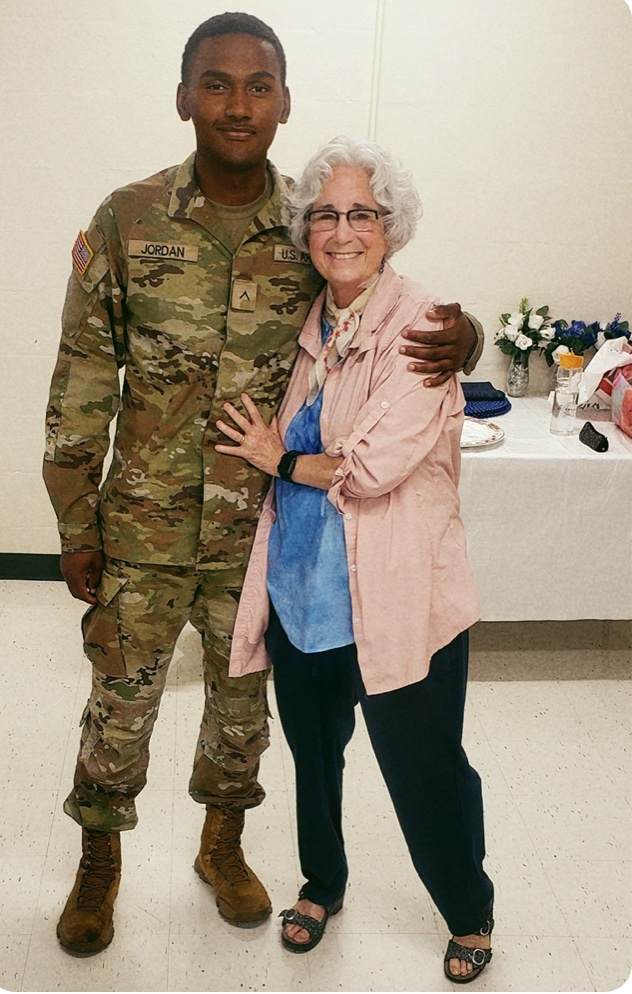
Six years ago, this young man started 7th grade at Maranathan Academy as a critically at-risk student. I had just started volunteer-teaching creative writing. He graduated HS and enlisted in the Army. Last week, on leave after boot camp, he walked into class as a surprise for me. I guess you can tell how I felt about that.
Screenshot
I’ll let this be.
T.K. Thorne writes about what moves her, following a flight path of curiosity, reflection, and imagination. Check out her (fiction and nonfiction) books at TKThorne.com
A true and funny story that happened a few years ago. It’s about angels and life and Bob. This is a rewritten repost but something set me thinking about Bob, and he is worth a revisit!
I was thrilled that my book had won a national award but didn’t think it was worth a trip to Chicago just to get a photo made. Sister Laura, however, was hyped about it. She had worked hard with little credit—editing, designing the original awesome cover, marketing, and supporting me at every step of my novel about the wife of Lot (Angels at the Gate). She also wanted us to attend the BEA (Book Expo America), which was happening simultaneously.
Thanks for reading TK’s Korner! Subscribe for free to receive new posts and support my work.
A few days before our flight, Laura fell and hurt her ankle. BEA requires lots of walking, but she was determined to go, even if she had to get a wheelchair. Where most people would have rented one, my always-check-a-thrift-store-first sister borrowed an old wheelchair from a thrift store. It was heavy and squeaky, and not knowing its history, she had cleaned it with Lysol, which was a prudent sanitary move but, unfortunately, set off the explosive-substance detector at the Birmingham, Alabama airport.
So, wheelchair, Laura, and all of her stuff had to be hand searched. And they confiscated our wheelchair, in case it was really a bomb, I guess, promising it would be at the gate waiting for us when we arrived in Chicago.
Not.
No wheelchair at the gate when we landed in Chicago. Had it exploded somewhere? We finally track it down in baggage. After a start like that, we are surely over the hump. All we have to do now is get outside the terminal because Laura has arranged for her friend, Bob, to pick us up. I’d never met Bob, but he was Laura’s friend. What could go wrong?
Bob, it turns out, is 82 years old. His car is about the same age and smells strongly of gasoline. I have visions of someone in front of us throwing out a lit cigarette. Are we going to explode after all? Will the Lysol on the wheelchair add to the incendiary mix?
Bob hops out and loads us up, pulling stuff randomly out of the hatchback area to get our suitcases and the wheelchair in and then crams piles of boxes on top of them, keeping the hatch down with bungee cords. When we get in the car, I politely mention that the boxes totally block his vision on one side.
“I’m used to it,” he says, pulling out into the rain and the insanity of the Chicago airport traffic.
The “it” he is “used to,” I realize, is not being able to see . . . omg!
I text our hostess. *Landed. If we survive Bob, will be there soon.*
Miraculously, Bob gets us where we are going, an area several miles north of Chicago in Edgewater, where Laura has arranged rooms at a friend’s cousin’s condo. Why, my always-check-a-thrift-store-first sister had reasoned, stay at an expensive hotel? It is a lovely place, but this is the award night, and I am worried about us getting back into Chicago. That ride was not part of the Bob-bargain, so we are on our own. That’s a good thing, right?
At Laura’s insistence, we forgo a taxi because we are so far away, but Laura has called the Chicago Transit Authority, and they assured her that all the metro train stations are handicap accessible. Still, it is no longer raining, and we leave the condo early, me pushing the squeaky, cumbersome wheelchair that I learn randomly applies its right brake and jerks hard to the right. I should have had a clue that the plans made by a woman who borrowed a wheelchair from a junk shop, not to mention, Bob, might warrant follow-up. When we arrive at the nearest station, we find there is, indeed, a way to get a wheelchair into the station. But “handicap accessible” does not stretch to a way to ascend the many stairs to the subway platform.
Reversing course, we head to next station down the line, which does have an elevator and where we meet a nice young man with the Chicago Transit Authority who helps us up to the platform. I ask his name.
“Angel,” he says.
My first thought is how appropriate—the name of my book is Angels at the Gate! WAIT! The name of my book. . . omg, I have forgotten a copy of my book (necessary to hold when getting picture taken at awards.) The last thing the publicist said was, “Don’t forget a copy of the book for the photo.”
I leave Laura on the platform with Angel, hurrying back to the condo. By this time, my feet are aching in my boots (which I am wearing because my skirt rises too far in front for knee-high stockings, and I will die before wearing pantyhose.)
I grab a copy of my book and switch my boots (which are apparently not the kind “made for walking” for sandals. Still need the socks, because this is Chicago, not Birmingham. I look down to see two bright pink big toes peeking out through holes in the socks. (There is a side story about those hot pink toes and a family pig who thought they were something edible, but there is enough hilarity in this story and besides . . . that wasn’t funny.)
Whoops, sandals not going to work for photo opt. I grab boots for later donning. By the time I get back, we are running late. We set the brakes on the wheelchair but, besides randomly engaging, they are not that spiffy about staying engaged. At the first lurch, Laura rolls down the aisle. I run after her, trying to catch her before she crashes at the other end.
A second angel jumps from her seat and shows us how to lock in the wheelchair. Who knew? We are from Alabama. We don’t have subways. Every decent individual is expected to own two cars and a truck.
The clock is ticking. The whole purpose of the event is to get that photo op. We are a long way from our stop, the closest one to the (Sears) Willis Tower with an elevator to get down to the street. I have yet to figure out why a sub-way is “up,” but that’s the way it is.
As we discuss strategy for when we exit, a third angel pops up from her seat—apparently getting a signal from above (or perhaps watching our entrance) that there are some Alabama girls in need of assistance—and plops into the seat next to me.
“You’re going to Willis Tower? I work near there.” She kindly explains which way to walk from our next stop. We are so late now that we must take a cab.
Holding our breath against the olfactory assault in the elevator, we descend to the street. I step out into the roadway and hail a cab for the first time in my life. (Again, I live in Alabama. Did I mention something about the pet pig in the family?) A cab driver stops and looks us over, shaking his head at the wheelchair before driving on. I hail another cab, who also shakes his head at the wheelchair. There is discrimination in this city. We push on to Willis Tower, rolling through the puddles and treachery of cracked sidewalks. We are now very late.
I push the rickety wheelchair as fast as I can until we hit a crack in the sidewalk that stops us dead, shoving the wheelchair handles into me and nearly dumping Laura, book, and boots onto the sidewalk into a puddle because, yes, of course, it is now raining again.
Willis (Sears) Tower is massive. We enter and proceed via elevator to a winding corridor down to the security station, surely close to our goal, only to find we are at the wrong door and have to be escorted through the labyrinth of the Tower to the service elevators in order to reach 99th floor and the Independent Publisher’s party and awards announcement. We are finally here! We register, pick up our ID’s and a program . . . from which we learn “Historical Fiction” is #15 on the list and they are now announcing #26.
We missed it. All the way from Alabama to Chicago . . . and WE MISSED IT!
I wheel Laura to the bathroom. I feel worse for her, since she really wanted this, and it is as much her award as mine because cover design and layout are also considered, along with the story and writing.
While waiting for her, I notice we are sort of “backstage” to the awards announcer, and a beautiful young woman is standing (on the stage) with her side to me, so close I could touch her with a step. She is obviously connected to the proceedings. Hearing one of my father’s oft-repeated life lessons in my head— Only the squeaky wheel gets the grease— I take that step and tap her shoulder between photo setups, whispering that we had difficulties and just arrived, and is there any way we could go out of order? She steps out of the big room and consults a list, asks my name.
“T.K. Thorne.”
She brightens. “Oh, you are T.K. Thorne? I loved your book!”
“You read it?”
“Yes, I really loved it; it was my favorite book out of all of them.”
There are 80 national categories. No idea how many submissions in each category or how many she actually read, but that’s a lot of books, even if she meant in my category. As far as I am concerned, I am happy.
Dianu. (Hebrew for “It is enough.”)
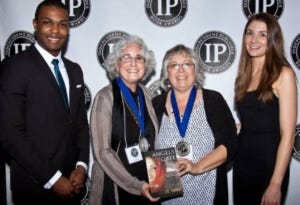
She graciously arranges for us to get called up, Laura hobbling at my side. They put a huge medal worthy of the Olympics around my neck and, to my delight, around Laura’s too. And I have the book in hand! Success! Photo snaps.
You wouldn’t have even seen the pink toes.
We head to the bar.
Over the next several days we encounter angels and references to them in rather odd ways. In addition to the transit guy named Angel, another “angel” (whose friend is Angela) shows me how to use Uber (Yea! No more wheeling for blocks to the train station); the Egyptian uber driver mentions his son’s name is translated as “Angel in Heaven”; and a book publicist at the Book Expo America (BEA) advises me to “listen to my angel.” I keep looking for a flutter of wings out of the corner of my eye!
On our last day, Bob picks us up, and we load wheelchair and baggage. After bungee-cording his car hatch down (not because of our luggage, just normal procedure), we are off to the airport with an extra hour . . . just in case. It is bitter cold, but I roll down my window because I can’t afford losing any more brain cells from the fumes. This time I am in the back seat. There is so much stuff in this car, the clutter is unidentifiable. I try not to think about what all could be in there and just hope there are no rodents that live near my feet. I reach for the seat belt. I actually find one, but there’s no buckle, so I just loop it around one shoulder. There’s a chance if we hit something at just the right angle, it might help. Laura is in the front seat. “What’s that noise?” she asks, forehead wrinkled in concern. Is it the engine?
“I don’t know,” Bob says. “Haven’t heard that one before.”
Laura: “Sounds bad.”
Bob: “Unless the wheels fall off, I usually just turn up the radio.”
I couldn’t make this up.
Postscript: Despite appearances, Bob was one of the many Chicago angels, for sure. He has spent most of his life traveling around the world helping people in disasters, which is how he and Laura met. I really wish I could spend more time with him and hear his stories . . . just not in his car.
T.K. Thorne writes about what moves her, following a flight path of curiosity, reflection, and imagination. Check out her (fiction and nonfiction) books at TKThorne.com