How To Know If You are a “Real” Writer

HOW DO YOU KNOW IF YOU ARE  A “REAL” WRITER?  This question has plagued me for a long time, and I saw it recently on a writing web site, so I am not the only one who has asked it. For a long time, I was unpublished and wrote in the “closet.” I was afraid if I admitted to doing it (writing, folks) I would have to face that dreaded question:

“Oh, what have you published?”

To which, I’d have to say, “Well, nothing… but my mother loves my stuff.”

And then go crawl under a rock.

I’m sure there are people out there for whom this would not be a problem, people who have lots of self-confidence and don’t care what anyone thinks of them. I tip my hat to you. For the rest of us, what to do? Should we go to the writer’s conference and expose ourselves as wanna-bes or should we just stay home?

Now that I have several novels and nonfiction books published, I have the perspective to return to this perplexing question. How do you know when you are a “real” writer? What is one? Does anyone who picks up a pen or taps on the computer qualify? Do you have to be published? How many times? Does self-publishing count? Does payment in art journal copies qualify or do you have to be paid for it? If you win an award or get an honorable mention, does that jump you to the “writer status?” According to the IRS, a professional is anyone who is paid for their work. My first publication to a magazine netted me $8.48. It was a great feeling to finally reach that milestone, but somehow it didn’t make the question go away.

Is the aspired distinction merely to be found in the eye of the beholder? If I like what you write, does that make you a “writer” in my eyes, but if I don’t care for it, you aren’t? Saying someone is a “good writer” or a “bad writer,” at least slaps the tag on them, but is he/she a “real” writer? If you keep a journal under the bed and scribe in it daily, are you one or not?

Okay, I’ve asked the question, now I’ll share my epiphany.

By college, I was quietly writing fiction, but I took a class in poetry because it was the only way to get my roommate to go to biology lab. It turned out to be the best move I could have made. Everyone brought their hearts and souls to class with their poems. And it was brutal. I learned that there was only one rule—Does it work?

Not: Does it express what you really want to say? does it use alliteration and rhyme correctly? Only: Does it work? You can break rules; you can follow rules; you can cry big crocodile tears onto your paper, but the only question is that one.

So, it doesn’t matter if you are published or not, have won awards or not. It doesn’t matter what you write or how often you write. It doesn’t matter. A writer wants it to work! If it doesn’t work, a writer is willing to produce it for critique, to listen to criticism, to cut, to add, to change, to ask questions, to learn, to rewrite, to stand his/her ground, to start over, to rewrite again—whatever it takes to make it work.

Of course, you can write without being “a writer.” And there is nothing wrong with writing for your own pleasure or self-discovery . . . or for your mother. Kudos to you and keep writing!

But if you have a passion to tell a story, to paint in words, to reach people, to move people, then you understand the question—Am I a “real writer?”

And if you have that passion and are willing to work to make your writing “work,” then in my book, you most definitely are one!

Blackrosedividersmall

T.K. Thorne is a retired police captain and award-winning writer of books and blogs that go wherever her curiosity and imagination take her. Visit her at TKThorne.com.

Posted in How to Know If You Are a Real Writer | 14 Comments

Ballooning Over Cappadocia

(For Çimen Filliz PAŞA)

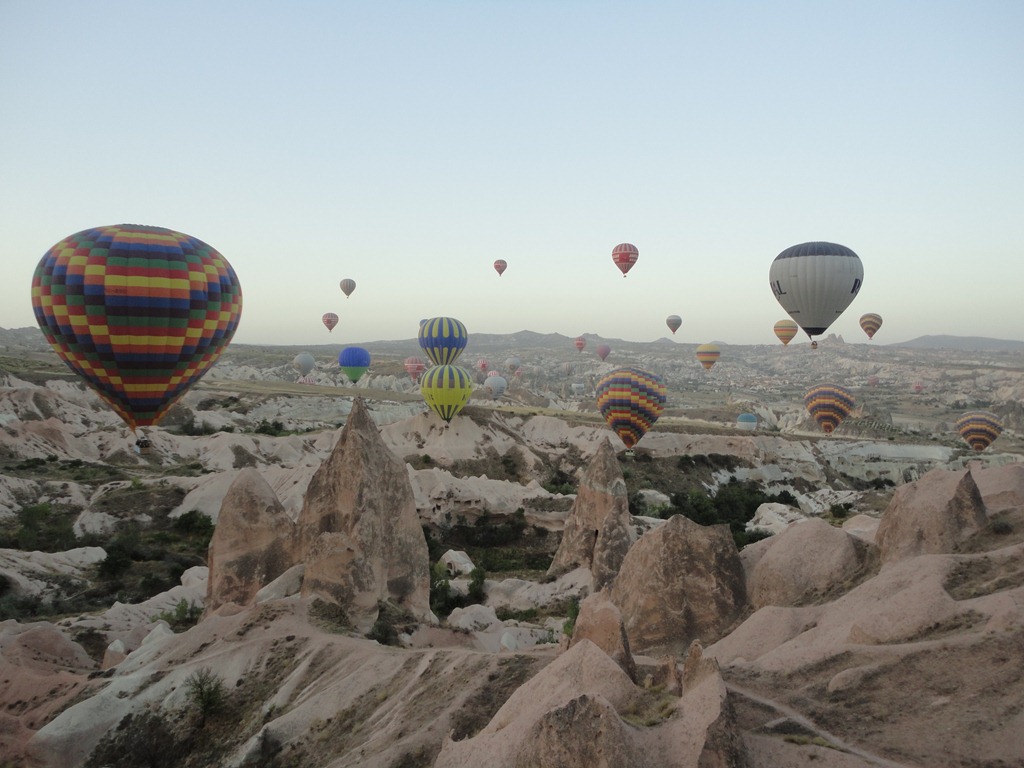
From the predawn womb, a fire-finger tipped with gold spouts into a wrinkled spread of fabric. Slowly, the balloon-to-be stirs awake, opening her mouth wide to nurse on the warm gusts.DSC01133.jpg

In the distance, great ovals–fellow balloons suffused with the light of their own fires–flash bold colors in encouragement.

Now, our newborn rises above the flame, tethered to the earth and her need for more air … more … and more. While she feeds, we climb into her basket, watching her sides expand above us into a massive cylindrical sail. When she is satiated, hands reach to untether her and, ever so gently, she lifts.

DSC01122.jpg

Cradled in a mother’s woven arms, we rise above the land of mothers.

Up, into a holy quiet punctuated with the roar of flame throwers–

–we are moved to silence.

In the morning light we join the others, a troupe of ascending jellyfish gliding the ocean depths. Our balloon feels the wind and gives to it, but keeps us close to her so we feel nothing as we slide through the silk of sky.

DSC01164.jpg

Below us opens a panorama shaped by ancient violence into alien towers and creases, into cliffs streaked with colors from cream to rust, and fairy castle cones that spear the air, their pocked sides a refuge to fox and man.DSC01147.jpg

We tease the cliff face, skimming close enough to snatch a breath or tuft of grass. With a laugh at us, our balloon catches the updraft and lifts to greet her brother sun, seeming to pull him up like a bauble over a ridge crest.

DSC01155

Too soon, we descend. Too soon, we stand, creatures of the earth again and watch our balloon settle and collapse. She dies with quiet dignity, the dignity of one who but falls into slumber, only waiting to awake again and kiss the sky.

black-divider-th

T.K. Thorne is a retired police captain (Birmingham, Alabama), director of City Action Partnership, and an award-winning author of fiction and non-fiction.

Posted in Ballooning over Cappadocia | Tagged , , , | 4 Comments

The Whirling Dervishes of Cappadocia

Tell me how wonderful I am or I will strike you with lightening, cause your fields to lie fallow and your women to be barren!


Why would an omnipotent God, or even powerful gods, need to be praised? It seems an egomaniacal, neurotic demand. “Praise” has never a comfortable concept for me. But twice in my life, experiences have shifted my understanding. The first was in a room of believers who raised their voices in spontaneous musical “praise,” each individual contributing whatever he/she felt moved to create. Somehow, all that miscellaneous individualism coalesced into a glorious harmony. To compare it to even the best choral performance would be like trying to pass a piece of glass as a diamond.

The second came unexpectedly in Cappadocia, Turkey, where I was privileged to sit on the front row and see the famous Sufi Whirling Dervishes. Contrary to the spontaneous singing, this was a scripted, formal service and yet… Well, let me start by saying I was expecting men in white robes and funky hats to spin around in circles like children, but without the dizziness. And, after a solemn introduction of chanting and music—wooden flute, a stringed instrument, and drums–that is exactly what I saw, and yet…not at all what I saw.

They entered the dimly lit square area beneath a domed ceiling, stately figures covered in black, their tall, cylindrical hats representing tombstones, a reminder that life is a whisper on eternity’s wind. Each knelt and bowed, sitting quietly for a while. Then one by one, they stood, shed the black cloaks and began to turn, hands crossed on their chest to represent the oneness of God, the weighted hems of their snowy robes lifting. After a moment, their arms rose as though gravity no longer claimed them, caught in the vortex of the whirl like filaments of spider silk in a gentle waft. One hand cupped upward, filling with the vibrancy from above, the other down to the earth, symbolizing the dervish’s position as conduit between both. There was a moving simplicity in their spinning, a reflection of the elemental nature that lies in the indescribable smallness of the sub-atomic and the unimaginable vastness of space. The whirl of energy’s essence; the spiral arms of a galaxy.

In some mysterious way, the audience became participants in the dervishes’ peaceful, joyful state. This was worship…but the word is flawed. It doesn’t convey the fact that praise is not the Holy’s need, but ours–our need to connect to that which is both beyond ourselves and the essence of our true selves, to recognize that our skin is only the most temporary container.

To maintain that awareness for an extended period of time, as whirling dervishes, yogis, or monks do, takes a great deal of practice, but such intensity is not a requirement the Universe imposes. Nor is the phenomenon of a spontaneous melding chorus. All that is needed, I think, is that we lift our focus from busyness and recognize any of the countless moments that wait for us everywhere–moments of the holy, moments of praise.

black-divider-th

T.K. Thorne is a retired police captain (Birmingham, Alabama), director of City Action Partnership, and an award-winning author of fiction and non-fiction.

Posted in Whirling Dervishes | Tagged , | 4 Comments

Travels in Turkey- A Strange Intimacy

A Strange Intimacy

For most of the previous month I was privileged to be a guest in Turkey where I hunted in vain for a downtown in Istanbul.  In a city of 13 million, everywhere is downtown.

Many things surprised me, such as the secular politics in a country that is 98% Muslim.  Many things felt alien, like the volcano-wrinkled, fairy chimney landscape in the region of Cappadocia. But some things made me feel right at home—particularly the wonderful hospitality of the Turkish people.  At every turn we were offered a cup of hot tea, the traditional Middle Eastern welcome to a guest.

Turkish architecture is a wonder–splendid buildings, seeped so deeply in history as to make the American Revolution appear yesterday’s news–from the extravagance of the Ottoman sultan’s palace, to the ruins of ancient Troy, to mud huts of the Neolithic Age.   As you can guess, a few experiences required pen to page.  One was a visit to the Gallipoli, where I formed an unexpected conclusion:

There must be a strange intimacy in battle.

Gallipoli is a peninsular of land that sandwiches a narrow body of water called the Dardanelles between it and the western coast of Turkey. It was strategically important in WWI because it provided the only sea access to Istanbul from the Mediterranean.  The Ottoman Empire had sided with Germany during the war.  After a failed British naval assault, New Zealand and Australian soldiers landed and assaulted Gallipoli’s slopes.  A precise number of casualties from this long, brutal encounter was never calculated because of the extreme conditions of the campaign, but over 250,000 young men died there. At one point, the Turks ran out of ammunition and a young general, Mustafa Kemal, commanded his soldiers to lie down and attach their bayonets. Mustafa needed them to hold until reinforcements could come, famously saying, “I am not asking you to fight for your country, but to die for it.”

And die they did.

Trenches lined with hewn branches, still crisscross the area where the Turks held their line. They were so close to the enemy that within three minutes of advancing, every person in the front trench died. As soon as they fell, those in the trench behind, who had watched their fellows cut down would move forward to take their pace. Such was the bravery shown on both sides, that when the fighting lulled, the Turks took water to their enemy, and the New Zealanders and Australians sent chocolate to the Turks, who had never encountered it before.  Mustafa Kemal’s words, memorialized on a stone monument, spoke to the mothers of all the foreign soldiers and told them not to weep for their sons, because all those who had bled on Turkish soil were now Turkey’s honored children.

Turkey has since had close relationships with their former enemies.

Deadly adversaries fight and become friends. Confusing, yet, it happens repetitively. In the European theater of WWI men called a ceasefire and met on the bloody battlefield to celebrate Christmas together.  In the oldest story known, written on clay tablets over 4,000 years old, Gilgamesh, a king of Mesopotamia, fights a fierce battle with the wild man, Inkidu. When it is over, they immediately become beloved and inseparable companions.

There must be a strange intimacy in battle, at least battle where you can see your enemy. Perhaps you recognize yourself in your foe.  If there is an opportunity to do that, perhaps respect can replace hatred and create a chance for peace.

Perhaps this phenomenon depends on the close quarters of hand-to-hand combat, the shared misery, or the fact that both sides fight for perceived honorable causes. I am not at all certain that modern warfare—dropping bombs from the air, shooting rockets to a distant target or using remote drones— produces this kind of relationship between combatants.  Soldiers’ experiences are as varied the nature of war, but perhaps some American forces fighting in the rugged mountains of Afghanistan or the streets of Iraq may have come to respect their enemy and vice versa. Perhaps they shared a wish to meet under different circumstances, to exchange pictures of their families and a cup of tea….

black-divider-th

T.K. Thorne is a retired police captain (Birmingham, Alabama), director of City Action Partnership, and an award-winning author of fiction and non-fiction.

Posted in A Strange Intimacy | Tagged , , , | 4 Comments

Tribute to Allie

There is a lot to do, but I am unable to do any of it. Today, my dear friend, Allie, died. She was not young. She couldn’t move as she once had, couldn’t race the car up the driveway like a blur of shadow or jump onto Daddy’s lap without an assist. When the puppy pulled her tail, she could only turn and bark.

When did that happen? How did it happen?

Last night, I looked at her and thought, She won’t be with us long. What made me think that? This morning when I let her out, she stayed on the porch and looked out over the pasture in a serious, sad way and, though I needed to get ready for work, I watched her through the window and wondered what was going through her mind.

What made us do that? Did she know somehow? Did I?

The dog has been humankind’s companion for thousands of years. We have evolved together. We claim to have “evolved” them, changing their shape and color, but I do not doubt they have affected us in powerful, profound ways that we cannot begin to name. If so, I think we have been the beneficiaries. Perhaps we are kinder, more faithful, more capable of love as a species because of them. Would we have killed each other long ago, but for the tiny tinkering with our psyches their presence in our lives has wrought? All those years ago, around the fire–dog with human–watching the night dark for us, hunting with us,  laying heads  on our knees,  anxious eyes melting our anxieties?

It is said that language divides our species. That we have it and animals do not. Language is, at its base, the use of symbols. Yet once, when I was watching TV, Allie went to the kitchen and started knocking her dog dish about. That in itself is the use of symbol to communicate, but when I poured dog food in her bowl, she merely sat in front of it, not touching it, and stared at me. When I looked up from my seat on the couch, and she saw she had caught my eye, she looked down at her bowl, back up at me and then, over her shoulder. She repeated this sequence exactly until I (dumb human that I am) finally understood. There was leftover food on the warmer behind her, and she was trying to tell me that she would like some, thank you. She could have just jumped up and put her nose on the warmer tray, but that was not allowed, so she “told” me as clearly and politely as she could.

What are we missing in the silence of non-words that is not silence at all? When will we learn to see what we can’t hear?

They come into our lives, and then they leave us heartbroken…but better.

Postscript

Two days after we lost Allie, a formerly homeless man named Glenn burst into my office.  “Teresa, I need your help!” he said in his thick Cajan accent.  Glenn has been volunteering with our organization since Hurricane Katrina.  He rides a bike around downtown and often stops by to chat or just say hello.  Sometimes he comes with problems, like when he needs help with paperwork, or setting up an email account, or when his long-time love died.

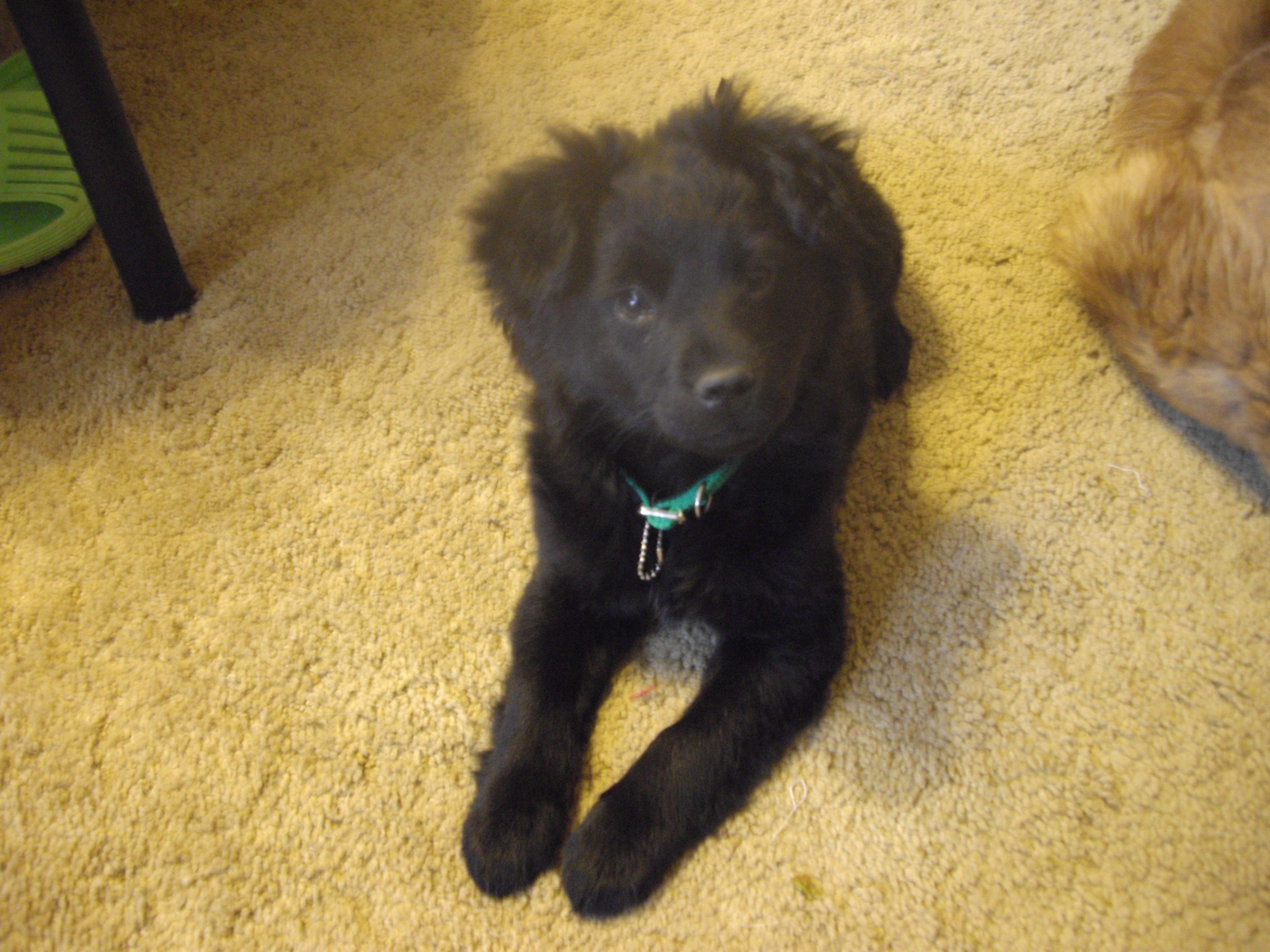
So I wasn’t too surprised that he had come to me with a problem.  He shrugged out of his backpack as he talked without pause, placing it on the chair opposite my desk.  “I found it in the road, and I didn’t want it to get run over.  I didn’t know what to do, but I knew you would know.”  He pulled down the sides of the backpack, revealing a solid black, fluffy puppy.

Stunned, I could only stare at it.  I was not taking a puppy to the pound, but I couldn’t  keep it.  I didn’t want another dog.  I wasn’t ready.  My husband was not ready.  We’d lost our dear Allie, and the hole was so deep and dark, we couldn’t go there.  Not now.  We needed time.

“Did you know we just lost a dog?” I asked Glenn–the only thing I could think to say.

“No, I didn’t.”  He looked startled, but I couldn’t grasp that this was a coincidence.  The whole scenario kept bouncing around in my head without giving me a clue what to do.

“It was running around in the street near where I live.  I called it out of the street and then it started following me.  You know I can’t keep a dog in my apartment.”

I was only partly hearing him.  I was still stunned.  I looked at that little puppy, solid black, like Allie, and I didn’t want anything to do with it.  Glenn lifted it up and I saw it was a “him.”  I didn’t want a puppy, I wanted Allie back, and I knew my husband would feel the same way, but it was as if some force bigger than I had put this puppy there for us now.  Glenn put the dog down, and the little fur ball ran into the break room to charm everyone.  I went after him and by the time I got back in my office, Glenn had disappeared.

I do not know if this was a casual coincidence, a gift from the Universe, or from Glenn, whose heart is bigger than he is.  Perhaps he did know about our loss and brought that puppy because he wanted to give me a gift to heal the pain he knew I was feeling.  He may have found the dog somewhere or he may have given up his own dog, I will never know.  But if so, it was a gesture of love I will never forget.
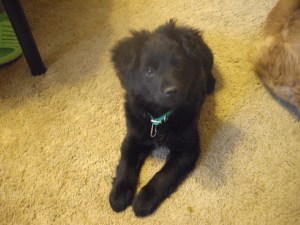
The puppy,  “Glenny,” is part of our family, and such a sweetheart!  He is not Allie, nor could he take her place in our hearts and memories, but he is a little bit of joy and life, and I think Allie would approve.  She always loved her puppies, even when they were kittens, even when she was too old to do much but lick them and bark to symbolize play she couldn’t quite manage.

We can do no less.

black-divider-th

T.K. Thorne is a retired police captain (Birmingham, Alabama), director of City Action Partnership, and an award-winning author of fiction and non-fiction.
Posted in Tribute to Aliie | Tagged , , | 10 Comments

The Magic of Mother’s Music

Solidago-juncea-Early-GoldenrodWhen the goldenrod plumes beckon in the autumn season, my mother would pull the car to the side of the road and wade into a stranger’s pasture to gather an armful.

I can still see her–standing at the sink, snipping the unwieldy stalks into line, singing a song, softly, as though only to the flowers, maybe promising them that once snipped and arranged, they will bring joy to all who behold.

And they did.

I can hear her at the piano, Chopin’s passion mingling with the smell of dinner cooking. It remains a mystery as deep as cosmic swirling how she concocted wonderful meals and dresses for me and my sister, kept our household going and our little genius brother occupied, and worked on improving education, the environment, and ethics laws in Alabama without seeming to lift a finger.

But I think maybe she danced to the music.

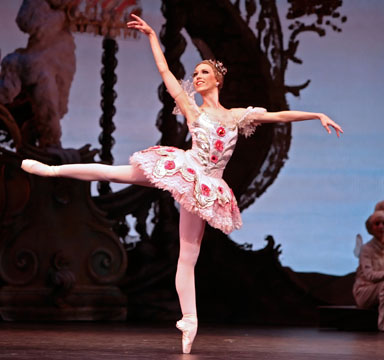
Once, Tchaikovsky flooded the house, and I discovered her lying prone on the back porch. She looked up at me and said, “I tried a little pirouette .” —Groan.  “I was the Sugar Plum fairy in the Nutcracker when I was sixteen, you know.”

sugarplum-fairy

“Oh, Mom, you’re not sixteen anymore.”

She sighed, “I know; I know.” Then she fixed me with her hazel eyes, “Don’t tell your father.”

Father was always fussing because Mother danced through life to music only she heard. She was oblivious to the open kitchen cabinet doors and the proximity of their points to her head as she moved about preparing a meal, not to mention the annoying cars and other road accessories that dinged her car because her attention was . . . elsewhere. With the music maybe. But she always returned right back down to earth when her children needed her to Band-Aid the hurt or feed them or give wise advice.

Only later, when she was gone, did I understand the challenges life dealt her or tried to. She never showed her hurts to me.

Once, during Thanksgiving I skipped down to the basement to retrieve the chocolate pies for our twenty-plus guests. My hands full on the return trip, I tried to switch off the light and ended up juggling both pies for a dicey moment before, like Mother’s pirouette, they performed a graceful flip in midair, landing with a smack, face-down on the cement floor. In tears, I reported I had ruined Thanksgiving.

“Of course, you didn’t,” Mother replied, snatching up a spatula as if it were a spear. “Follow me.”

And, of course, I did, trying to hear, between sniffles, the marching band in her mind.

With surgical skill, she slid the spatula between the floor and a layer of splattered chocolate and rescued the majority that had not actually contacted the floor onto a plate. “We’ll clean this up later,” she said, closing the basement door. I thought I heard snatches of the band as I trailed her back upstairs, but the glorious, perfect round pies were history, replaced with a chocolate mass, starred with Picassoesque bits of graham crust. In the kitchen, Mother sculpted the chocolate onto individual plates and smothered them with Cool Whip. With a smile, she handed me two to serve to the waiting guests and said, comfortingly, “Nobody will ever know.”

And they didn’t.

Mother even danced down grocery store aisles. Canned music was music, still. At an age where such behavior horrified, I lagged behind, lest someone connect me with that woman who randomly kicked a leg sideways and sang out loud as she pushed the cart. Though my feet dragged with a young girl’s reluctance to be singled out as different, my heart  glimpsed secrets:

• One could dare to be.
• A disaster is only one if you allow it.
• A wildflower has the potential for just as much beauty as a rose.

You just have to hear the music.

Jane Lobman Katz (1931 – 1986) – Alabama Women’s Hall of Fame

black-divider-th

T.K. Thorne is a retired police captain (Birmingham, Alabama), director of City Action Partnership, and an award-winning author of fiction and non-fiction.
Posted in Mother's Music | Tagged , | 11 Comments

Grandma’s Bag

Leaders sometimes appear in unexpected guise. “Grandma” Becky Davis would not have earned a second look had you noticed her on the street. You would’ve seen only a thin homeless woman with stringy, steel-grey hair and a bag on her shoulder. If you looked closer, you might have deduced a dose of Native American heritage in the straight back and the strong cheekbones. Grandma had no income, but the bag she carried held an assortment of food. Everyone on the street knew about her bag. If folks were hungry, they could reach into “Grandma’s” bag. If they had extra, they put something in.

If you followed Grandma “home,” two years ago, you would have found yourself in strange camp on the outskirts of downtown where a few people huddled around a fire. When Grandma grew tired, she bedded down in the shelter of an abandoned tractor-trailer cab. It reminded her of younger days when she drove an eighteen-wheeler across the country. She was also an honorary member of the Hell’s Angels. If you watched her giving another homeless person “what for” for slipping off the wagon, you’d understand that she could still hold her own. No drugs or alcohol were allowed in her camp. She, herself, had been sober for seven years, though she had her vices—smoking and a virulent sweet tooth.

She started drinking after her first husband died. When her second husband tried to kill her, she took a long, hard look at herself in the mirror and realized she was doing the job for him. She left him. . .her home. . .and her addiction to alcohol.

If you saw Grandma on a downtown street in midwinter, you might have wondered why she didn’t stay in a shelter or join her daughter in Georgia. It seemed bizarre that this elderly woman preferred a rat-infested shell of a truck cab to a roof and heat and regular meals. What was true, but harder to understand, was that when you have nothing in the world but the clothes on your back and your ability to make small decisions—when you can come or go; who your companions are; when you eat and sleep—those choices become precious to you. When you have little control over your life, small freedoms define your sense of dignity and self. Grandma’s daughter had her own problems as a single mother struggling to raise three children, and Grandma refused to add to her burdens by revealing she was homeless.

When Hurricane Katrina devastated New Orleans and the coasts of Mississippi and Alabama, an organization in B’ham, CAP,  collected more items than the refugees that landed there needed and started sending donated supplies to the coast. Volunteers from the community came in to help sort and pack. One of them was a thin woman with stringy, steel-gray hair and a bag on her shoulder. She said, “Those people down on the coast have it worse than I do!” And she worked all day and came back the next day…and the next. When the relief operation expanded to a warehouse, she gathered other homeless people she trusted, brought them in, and assigned them duties, but woe unto those who came to our door with any type of scam in their hearts. Grandma did not tolerate fools. Eventually, she earned the warehouse keys and the title of Warehouse Manager. She wore her red “CAP volunteer” T-shirts with pride almost every day for two years, explaining CAP services to anyone who asked …and probably to several who didn’t.

Grandma shared her idea about implementing a transit program she’d encountered where a homeless person looking for work received a two-month bus pass, free of charge. After those first months, if he’d found a job, he repaid the price of the ticket, so another person could use the pass. Sort of like Grandma’s food bag.

It took two years to get Grandma a disability check and housing. With the first income she’d had in a very long time, you might think she would buy herself something, but what she stubbornly insisted on was taking the people who had helped her to lunch.

Despite her years of sobriety, the damage to Grandma’s liver finally caught up with her, and she was in and out of the emergency room many times. To the medical staff’s surprise, the parade of visitors to her room included parking enforcement folks, homeless people, fellow hurricane relief volunteers, and CAP officers. Along with flowers and potted plants, several “illegal” milkshakes somehow slipped through security.

Each time Grandma returned to the hospital, she had to endure painful procedures, but she never lost her spirit. If you could have seen the woman who sat so straight in her bed, her face a road paved with life’s lines, you might have seen the ghosts of Native American ancestors who sat with her. You would understand that courage and determination…and leaders sometimes appear in strange guise.

Grandma knew she was dying. She had income now and could contribute, and she returned to Georgia to be with her daughter and grandchildren. She wanted the youngest to have some memories of her. If you had looked down and seen Grandma during the last days of her life, you would have seen a thin woman with steel-grey hair and a straight back, spending time with her granddaughter, teaching her that if you carry the bag for other people, someone will put something in it and someone will take what they need from it.

black-divider-th

T.K. Thorne is a retired police captain (Birmingham, Alabama), director of City Action Partnership, and an award-winning author of fiction and non-fiction.
Posted in Grandma's Bag | Tagged , , | 1 Comment

The Forgiveness of Whales

Until recently, scientists thought humans were the only species with the specialty brain neurons responsible for higher cognitive functions like self-awareness, a sense of compassion and language.

They were wrong.Whale-and-Man-and-Forgiveness

Fifteen million years before humans, whales began evolving these special cells*, and now a strange phenomenon is occurring off the Baja coast of Mexico.

Humans have been slaughtering Pacific whales there for a long time, first with harpoons, now with sonar from Navy ships. Whales live a long time, up to a hundred years. Some whales alive today still bear the scars of harpoons. Many scientists believe that it is implausible to think the whales do not remember this or associate humans with death and anguish.

Yet, in the same area where humans hunted them nearly to extinction, then tortured them with sonar, whales are approaching humans and initiating contact. A  N.Y. Times article detailed the experiences of the reporter and the stories of locals who tell about mother whales approaching their boats, sometimes swimming under it and lifting it, then setting it gently down. Almost all the stories involve the whale surfacing, rolling onto its side to watch the humans–reminiscent of the surreal moment in the movie, Cast Away, when a whale rises from the night sea to regard Tom Hanks with an eye cupped with starlight, an eerie intelligence, and a gentleness that moves us, for we know the massive creature could kill the castaway with a nudge or a flick of a tail fluke.

These real grey whales off Baja swim close enough that people invariably reach out to touch them, and they allow it. One person, reflecting on the experience said, “I have never felt more beheld.” It seems reasonable–given the position the whales place themselves in–that they seek the contact. In many cases, a mother whale will allow her calf to do the same. There is no food involved in these exchanges, only a brief interlude of inter-species contact and rudimentary communication:  I come as friend.

Why?

Where will humans be in another hundred years? I suspect we will be technologically advanced, but emotionally pretty much the same, even in a thousand years or ten thousand. But what about a million years? Can we evolve (if we survive) to a more sane, more rational, more loving species with a broader sense of our place in the universe and in life itself? Is it possible that these creatures with 15 million years of intelligent evolution on us, might regard us as a young species, children who don’t really know better,  and grant us leeway for our mistakes? Grant us . . . forgiveness?

If we humans could only do such a thing!  Beat our swords into ploughshares, at least among ourselves. It’s unlikely, but we might yet be targeted by alien invaders, so we shouldn’t throw away all of our weapons. Even whales have enemies, and they do not hesitate to defend themselves when attacked and even take the battle to the enemy! Recently, there are increasing reports of whales, specifically humpbacks, who are defending not only their own against attacks of orcas, but other mammals, such as other whales, sea lions, fur seals or walruses. They only attack mammal-eating killer whales, not orcas that primarily feed on fish. They feed and fight in a coordinated manner, communicating with each other.

There is proof that we humans are capable of realizing the power of peaceful cooperation and partnerships. Not long ago, for example, a team of over 2,000 scientists representing six countries worked to determine the human genome, all 3 billion parts, and then made that data freely available on the Web.

Perhaps one day we will stop slaughtering the fellow creatures on this blue-and-cream jewel that is our world; perhaps we will make friends and share discoveries, meeting whales on the mutual ground (or sea) of respect.

Our survival may depend on it.

*New research is indicating that glial cells may be responsible for imagination, creativity and probably play a role in consciousness. Einstein’s brain had an abundance of these cells, especially in the area responsible for spacial awareness and mathematics. Mice injected with human glial cells became 4x smarter. Glial cells can communicate with each other (via calcium waves) and with neurons, even signalling neurons to fire. Although whales don’t have all the “levels” of a human brain (and so their thought processes are probably distinctly different), whales have a much higher ratio of glial cells to neurons than humans in the neocortex, the area thought to be responsible for intelligence.
Resources:
http://blogs.scientificamerican.com/news-blog/are-whales-smarter-than-we-are/
http://scientificbrains.com/5-reaons-why-glial-cells-were-so-critical-to-human-intelligence/
http://blogs.scientificamerican.com/guest-blog/glia-the-new-frontier-in-brain-science/
http://www.scientificamerican.com/article/the-other-half-of-the-bra/
http://blogs.scientificamerican.com/brainwaves/know-your-neurons-what-is-the-ratio-of-glia-to-neurons-in-the-brain/
See below for other links.

black-divider-th

T.K. Thorne is a retired police captain (Birmingham, Alabama), director of City Action Partnership, and an award-winning author of fiction and non-fiction.

Other Related Links:
http://blueandgreentomorrow.com/2014/07/20/138000-species-under-threat-as-obama-approves-gas-and-oil-exploration/

http://www.takepart.com/article/2014/07/21/whales-and-dolphins-danger-obama-administration-approves-offshore-oil-exploration

http://www.salon.com/2014/07/18/choosing_big_oil_over_whales_obama_opens_east_coast_for_offshore_exploration/

http://animalperspectives.com/2014/07/20/oil-and-gas-exploration-on-the-eastern-seaboard-of-the-u-s-is-the-wrong-answer/

http://www.pressherald.com/2014/07/18/obama-opens-east-coast-to-oil-exploration-with-sonic-cannons/

http://www.nytimes.com/2014/07/19/us/white-house-opens-door-to-exploring-atlantic-for-oil.html?emc=edit_tnt_20140719&nlid=36553356&tntemail0=y&_r=1

http://news.msn.com/us/obama-opens-eastern-seaboard-to-oil-exploration

http://barnegat-manahawkin.patch.com/groups/politics-and-elections/p/court-rules-seismic-blasting-off-ocean-county-can-move-forward71876?ncid=newsltuspatc00000003#new_comment

Posted in The Forgiveness of Whales | Tagged , , , , , , | 12 Comments

Why Noah’s Wife Has Asperger’s

Noah’s wife has Asperger’s because walls and characters talk to me.

Talking wall:  Mural

I once organized the painting of a 140 foot mural on the side of the Police Administration building in downtown Birmingham, AL.  The mural design is a teenager’s winning interpretation of the Birmingham Pledge.   In the wall’s previous lifetime, it was attached to an adjoining structure.  When that section was ripped away, the repair left the outer wall smooth and white, pristine, a tabula rosa that shouted, “Paint me!” every time I walked by.  A radio station host blasted citywide that I was unstable because I heard walls talking.

In spite of this, the mural remains on the building, and it is my fervent hope that it speaks to other people every day.

Talking Characters: 

When I learned that the Bible gave only one brief mention of Noah’s wife, another tabula rosa opened before me. This unnamed woman had a story, a big story, and she was shouting “Write it!”  As I started to explore the possibilities, a scene formed in my mind of a young girl in an ancient culture speaking with her grandmother about the role of women.  As they talked (and I listened and typed), I realized Na’amah was special.  “My name means pleasant or beautiful,” she announced.  “I am not always pleasant, but I am beautiful.”  This girl saw the world in a different, literal way.  She spoke only truths because lying distressed her. I could see that this was going to get her into trouble in a culture that depended on the whims of the gods for survival.

I have had a long-time interest in autism, partly because it has affected my family and partly because it is a glimpse into the marvelous workings of our minds. In Noah’s Wife, Na’amah is an Asperger savant, a person with remarkable mental skills.  The term “Asperger Syndrome” was, of course, unknown in ancient times, but there is no reason to believe that the condition did not exist.  Most experts put it on the high-functioning end of the autism spectrum, although there is  disagreement about whether it should even be classified as a “disorder.”  Although every person on the spectrum is unique, persons with Asperger’s are usually highly intelligent. Some (about 10%) have extraordinary recall and obsessive knowledge about areas that capture their interest.  Na’amah’s passion was the sheep she tended on the hills of ancient Turkey. She preferred their company and her skills of observation gave her a deep knowledge and understanding of their behavior.

Why did I gave the central character Asperger’s?  The answer is multilayered.  Brain developmental disorders and particularly the phenomenon of savants have always intrigued me.  If it is possible for some brains to perceive the world differently and to have extraordinary skills, the potential must exist for all humans.  In fact, there have been experiments where scientists have used magnetic pulses to temporally “shut off” a portion of the brain (anterior temporal lobe) in non-autistic persons, resulting in the temporary production of savant abilities.  Fascinating stuff!

Also, I believe my own family has been affected by undiagnosed autism or Asperger’s. My uncle clearly had mental developmental issues and displayed several of the symptoms of Aspergers. Only after reading one of Dr. Temple Grandin’s books (as research for my novel) did it occur to me that my uncle might have a visual/audio processing issue as well.  All my life I thought he hated me because he would not look at me or respond to me at all. After reading Grandin’s Animals in Translation, I visited my uncle in the hospital (dreading it) and asked him a question, knowing he would not answer me, but this time, as an experiment, I waited and didn’t say anything and, after what seemed a long while, he looked at me and responded as if we were having a normal conversation. It was quite a moment, and we were able to converse until he died some months later.

For my novel, I wanted to have a character who did not automatically accept all the precepts of her culture, but I had no conscious intention of giving her any kind of syndrome. As I wrote Noah’s Wife, however, the character of Na’amah began to take on a life of her own (one of the joys of writing).  She surprised me with her unique perspectives, her obsession with sheep, her propensity to be literal and, by the end of the first chapter, I realized that she had Asperger’s. To be honest, I struggled with this for a while, but in the end, I conceded that it was more important to let Na’amah be who she wanted to be than to put her in the box of who I thought she should be.

I was in for an interesting journey with this story, a unique twist on the Biblical account based on evidence of a great Black Sea flood 6.5 thousand years ago, and I wanted to see what Na’amah would do and say and where she would take me.  She often surprised me with her observations, the depth of her spirit, and how what seemed her handicaps became strengths.  When the book was finished (four years later) I missed her.

Yes, my characters tell me things I don’t know, and walls talk to me.  I admit it.

Aren’t I fortunate?

black-divider-th

T.K. Thorne is a retired police captain (Birmingham, Alabama), director of City Action Partnership, and an award-winning author of fiction and non-fiction.

Noah’s Wife & The Titantic:              About the Book             More Behind the Scenes Info

NOAH'S WIFE COVER for AUDIBLE for web

Click image for audio sample and special offer info

Titanic

Posted in Why Noah's Wife Had Asperger's | Tagged , , , , , , , , , , , , , | 6 Comments