The Reader’s Mind: A Writer’s Most Important Tool

I am handicapped.  Might as well admit it.  It’s a fact well known to my dogs.

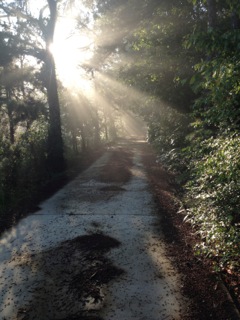
The walk down our driveway to the barn is one I take every morning to feed the horses.  Pugsly and Glenny always go with me, and every morning they bounce with excitement, as if they have never been the route before.

Morning Walk

Morning Walk

Glenny is off on a mad dash, tracking something he has no hope of catching and wouldn’t have a clue what to do with if he did.  A clump of grass arrests Pugsly’s attention.  He freezes to digest the story about an intriguing creature that, perhaps, passed by in the night.  I’ve no idea what he smells, but urine (I understand) has a rich tale to tell—what particular animal, its sex, its health, what it has eaten . . . for all I know, what it was thinking at the time!  To my dogs, I am a pitiful, handicapped being, ignorant of the ever-changing world of scent . . . and hearing impaired as well.

My loss.

But observing the fascination with which they explore the world of our driveway, I am determined to open my own senses to this path I walk daily.  It is the same everyday, but it is different—different wildflowers bloom, changing out the colors.   Last night’s rain and the morning sunlight string dew pearls on pine needles and halo a spider’s silk design.

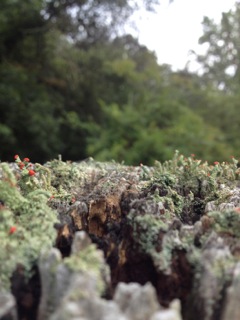
weblichensA suggestion of movement catches my eye—a slug on a wet fence pole.  The intricate pattern on its back mimics the variations of wood, making it almost impossible to see.  I never knew slugs came in anything besides basic black.  Also, for the first time, I note the forest of devil’s matchstick lichens that inhabit the top of another rough-hewn post, making a tiny world of deep crevasses and red-topped spires that exists right under my nose.

I get some satisfaction that my dogs missed these things.

As a writer, I know it is important to note the small as well as the large.   It is my job to make a scene real, so the reader can imagine it and be there in the story with the characters.  With the possible exception of people on the autistic spectrum, our brains screen out an enormous amount of detail, focusing the limited capacity of our attention on what it determines is important.  This process is enhanced in moments of tension—hence, the phenomena of perceiving only a narrow field of vision (like the end of a gun barrel) in an emergency.

Directors do the same thing with film, choosing certain angles or shots of facial expressions, telling details that give us much more than what we are actually seeing.  Even the music that plays gives us subliminal hints about how to interpret the information pouring into our brains.  We have evolved to attend to specific details and populate the rest of the world around it.  A skillful writer will often direct the reader’s attention to a small detail, describing it in a way that makes the whole environs pop into the reader’s reality.

The lantern bobbed with the ship, leaking a shifting orb of pale light into the dark corridor.

Did you hear the creak of the ship; the slap of waves on the hull?  Did you smell the sea?  Feel the sense of mystery or suspense?  If you did, all of that was created by your own mind, the most powerful tool in a writer’s arsenal.  Every moment is comprised of thousands of bits of information.  A writer cannot possibly describe them all and does not need to.  Sometimes a whiff is all it takes….

black-divider-th

T.K. Thorne is a retired police captain (Birmingham, Alabama), director of City Action Partnership, and an award-winning author of fiction and non-fiction.

Posted in A Reader's Mind | Tagged , , , , | 4 Comments

To Dream the Possible Dream

I have a dream

Fifty years ago today, Martin Luther King urged us to judge people not by the color of their skin, but by the content of their character.  There is no question that poverty and lack of equal education can affect the course of people’s lives, and we should be putting research, resources, and wisdom toward changing that, but there have been many people from those circumstances, of various shades of skin, whose character has been a shining light to our world.

There are times when I am ashamed to be a human being—when I see what our thoughtless consumption and greed are doing to our ecosystem or how we treat each other.  But when I consider those people who live to their potential, especially those who have done so despite the challenges of their circumstances . . . I am proud to be.

black-divider-th

T.K. Thorne is a retired police captain (Birmingham, Alabama), director of City Action Partnership, and an award-winning author of fiction and non-fiction.

Posted in To Dream the Possible Dream | Tagged , , , | 3 Comments

The Wise Win Before the Fight

Morhei Ueshiba

Morhei Ueshiba

Violence surrounds us—in the media, in our entertainment and sometimes even in our homes.  From the streets of Chicago, to the wars in Iraq and Syria, to video games—violence is a way of life.

Must it be?

“Those who are skilled in combat do not become angry.  Those who are skilled at winning do not become afraid. Thus the wise win before the fight and the ignorant fight to win.” –Morihei Ueshiba

Anger is oft a child of fear. The bond between fear and anger melded in our long-ago past when many of our choices boiled down to Flight/Fight.  Chronic anger is often a component of depression because our mind/body doesn’t know the difference between a “real” danger and one that originates from our mind and/or body.  I awake from a nightmare panting, sweating, my heart racing.  My fear is as real as if I faced a physical snake crawling up my leg.

When a remark from a loved one makes me angry, I can usually pursue the emotion to its roots of fear.  How dare he say that? [Anger] If he can say that, does he really love me? [Hurt] And if he doesn’t really love me, what if he leaves me? [Hurt/Fear] And if he leaves me, will I grow old alone and miserable!  [Fear]  –A logical progression, but not a rational one.

We are evolutionarily programed to make those leaps, because in the world of the tiger-in-the-forest, we had to act quickly. We didn’t have time to ponder the root of our anger/fear, so our brains aren’t good at that.  Fifty bits of information per second make their way into the conscious brain, while an estimated eleven million bits of data flow from the senses every second.”*  We respond instantly to the emotional “gist” of the situation. We deceive ourselves very easily.  Seeking the roots to anger and pain is an uncomfortable journey that takes effort. It is easier and feels better (and safer) just to be mad.

In our society, the expression of anger is more acceptable (especially for men) than the expression of fear, and seeking power can be a way to manage fear.  Can a whole society be fearful?  As Master Ueshiba implied, uncertainty begets fear.  In a war zone (of any kind) one’s environment is fertile ground for fear. Subtle fears can infiltrate their way deep into our psyches; our relationships are riddled with fear mines.

Our cultures, as well—across the world young people are finding roadblocks to education or that their education is not an easy ticket to a job.  Frustrated and disenfranchised, they can turn to the sense of belonging and purpose offered by gangs, freedom fighters, or terrorist thugs. In many poor neighborhoods around the world, people have always been in economic crises, possessing neither the skills nor the hope of ever having the skills to succeed.  Fear of all sorts is an intimate and constant companion.

Is it any wonder our world is full of tangled expressions of anger and fear?

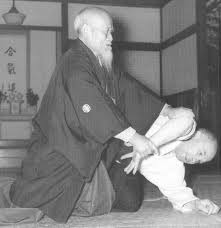
In Master Ueshiba’s Way (the martial art of Aikido) one learns understanding and compassion for one’s attacker.  Does this make the practitioner a “bleeding heart” who allows the blow to fall?  No, absolutely not, but in understanding, one can choose whether to break bones or step aside and allow the attacker’s force to bring him where he can do no harm.

One does what is necessary, not out of anger or fear, but out of compassion and understanding.  Compassion is not a passive emotional reaction but a call to responsible, rational action. Acting from a place of compassion, rather than anger, frees us from the tyranny of emotion that can eat us from inside and steal our happiness; it allows us to make good decisions.Aikido

Of course, “what is necessary” is not always an easy question to answer.  Perhaps the more fear, the more drastic the definition of “necessary.”  Was it necessary to drop an atomic bomb on Japan?  So many innocent people suffered terribly, yet it ended a horrible war.  History may classify Vietnam and Iraq as mistakes, but is all war a mistake?  What would have happened if we had not entered WWII?  Are the actions we are taking in the Middle East “necessary?”

I don’t Uisheba 2pretend to have the answers, only to suggest that we look behind anger and fear to find compassion and understanding for our enemies, so that we may know them and ourselves, and be among “the wise who win before the fight.”

black-divider-th

*Final Jeopardy: Man vs. Machine and the Quest to Know Everything by Stephen Baker.

T.K. Thorne is a retired police captain (Birmingham, Alabama), director of City Action Partnership, and an award-winning author of fiction and non-fiction.

Posted in The Wise Win Before the Fight | Tagged , , , , , , , , | 8 Comments

A Hand; A Fist

hands-clip-art-10

What kind of world allows young American football players to feel comfortable making a video about raping an unconscious girl?  A world where the defense against a brutal, fatal rape of a student in India is that “respectable women are not raped?”  A world where a young Pakistani student is shot for going to school?

Today, NPR’s Diane Rehm discussed the political objections and support for the Violence Against Women Act and the daily attacks on women throughout the world.   This while we are all still reeling from the Sandy Hook massacre of children and staff at an elementary school.

What do these two subjects—violence against women and a mass shooting—share?  They are both about power.  In most individuals, the drive to power funnels into positive channels—a determination to make a business successful; craft an environment that ensures the best future for our children; cure disease; explore space or the ocean or the world of the quantum; render a painting that reflects our deepest emotions; or find the words that move a reader.  That is power.

There are also negative channels—the malicious release of a computer virus, the poisoning of trees: the sabotage of a fellow worker; the punch of a fist; the pulling of a trigger; even when the gun is aimed at the aggressor’s own head.  These acts are also efforts to establish or regain power.

Why do we struggle so to be the master of our environment, our emotions, or influence?

Survival.

In the millennia that shaped us, if we were not wired to seek power, we would have been eaten.  In an earlier post, The Most Important Question, I explored the question of whether our basic nature has evolved since we became “human.”  Recently, a research project added to that discussion when scientists found that the human hand, so intricately designed to manipulate and experience the world was also uniquely evolved to become a weapon, as a fist. We aren’t going to erase our nature, and if we did, we might loose all the best that we are or can be in the bargain.

What we can do, what we must do, is civilize ourselves with laws and education and support safety nets. We need to make abusing power, be it physical, emotional or political, unacceptable; to encourage a world where “success” is culturally defined by making the world a better place.

black-divider-th

T.K. Thorne is a retired police captain (Birmingham, Alabama), director of City Action Partnership, and an award-winning author of fiction and non-fiction.

Posted in A Hand; A Fist | Tagged , , , , , , , | 6 Comments

The Next Big Thing

In school, my study method of choice was “The Cram.”  The further behind I got, the more motivated I was.  So, maybe I shouldn’t have been surprised to find myself writing two books  at the same time.  (Can somebody get me an appointment for a mental evaluation?)

When I was invited to answer questions about the Next Big Thing, i.e., my “work in progress,” I was torn about which one to talk about.  Of course, I waited until the last moment (see above) to make a decision and get to it, but after staring at the fork in the road for a while, I decided to go with Robert Frost and choose the path less traveled or, in this case, the work less known.

Extra Bonus:  This post is part of a “blog chain.”  That means you get a wealth of blogs and exciting new writers  to explore!  I was invited by Debra H. Goldstein.  Be sure and check out her blog and those of the next links in the chain listed below the interview.

Ten Interview Questions for the Next Big Thing:

1.What is your working title of your book?
Last Chance for Justice:
How Relentless Investigators Finally Solved the Birmingham Church Bombing Case

2.Where did the idea come from for the book?
In 2004, recognizing that time was passing and people from the civil rights era were aging, Birmingham held an event called “The Gathering,” where everyone associated with the 1963 Sixteenth Street Baptist Church bombing–victims’ families, civil rights supporters, investigators, attorneys, and the community–came together to tell their stories.  I attended and heard the two FBI investigators who worked the last case (late 1990’s) speak. The inside story was fascinating, and I realized  so many people had misconceptions about this case—the bombing that killed four little girls and had a major impact on the course of history.  There were three major investigations of the bombing over the years; the final one took five years, involved thousands of files, and some real heroes to bring the last two living suspects to justice.  I thought: This story needs to be told!  About five years later, I got that opportunity.

3. What genre does your book fall under?
It’s non-fiction.  My debut novel, Noah’s Wife, is historical fiction so, fortunately, I had experience doing research for a major project, and I certainly called upon it in writing this book!

4. Which actors would you choose to play your characters in a movie rendition?
Ha!  You are asking the wrong person this question.  I barely remember the names of my family!  I need two determined, but somewhat quirky good guys to play the lead parts.

5. What is the one-sentence synopsis of your book?
In Last Chance for Justice, a Birmingham Police detective and an FBI agent team up as reluctant partners on a 37-year old cold murder case, the last chance to solve a brutal bombing that killed four innocent girls and changed history.

6. Will your book be self-published or represented by an agency?
Chicago Press Review is publishing the book!  We hope to have it out by the Fall of 2013, in time for the 50th anniversary of the Sixteenth Street Baptist Church bombing.

7. How long did it take you to write the first draft of your manuscript?
Three years.  Interviews began in July of 2009 and continued until 2011, when I began trying to organize the notes.  (Just thinking about that task makes me shudder.  The actual writing was absorbing, but I am not an “organizer” by nature.)  The first draft of the manuscript was “finished” in the spring of 2012.  I continued to work on it until late 2012 and expect to do more work when the editor gets his hands on it.

8. What other books would you compare this story to within your genre?
Many people have written on the subject of civil rights, both historically and personally.  Frank Sikora was a Birmingham reporter who wrote Until Justice Rolls Down, a book about  the case, and he went into depth regarding the first conviction (1977).  My book covers that, but focuses on the last case (1997-2002) and the two investigators assigned to it.  It contributes unknown details to the story, because I had the opportunity for in-depth interviews  (approximately 20-25 hours), in addition to critical written documents, and because I was able to bring my own understanding of law enforcement into the writing.

9. Who or what inspired you to write this book?
As I mentioned, hearing the stories of the two men who actually worked the case sparked my interest, along with the realization that one of them was someone I knew personally. More than that, writing this book was a reconciliation of two divergent aspects from my personal background.  I grew up in Montgomery, Alabama and my family strongly supported civil rights. (The Ku Klux Klan burned a cross  on my grandparent’s front yard for their involvement in the bus boycott.) I was only a child during the years of tension, but it is a part of my heritage. I also (to the great surprise of my family) became a Birmingham Police Department officer and spent a career there.  It may seem an odd coupling, but both backgrounds gave me a unique perspective.

10. What else about your book might pique the reader’s interest?
On September 15, 1963 four young girls primped in the basement ladies lounge of the oldest black church in Birmingham, Alabama preparing for their church Youth Day. Without warning, a powerful explosion ripped through the outside wall, snuffing out their futures and setting the community ablaze. Everyone knew members of the white-robed Ku Klux Klan were responsible, but by the 1990’s, over a decade after the bombing, only one suspect had gone to prison. When the homicide case was reopened in 1997, no one thought there was any real chance of convicting the remaining suspects, especially the FBI agent and Birmingham detective assigned to the case.  Over time, their initially chilly relationship grew into a close partnership and together they built a case on the two remaining suspects and helped answer questions that have long haunted the case:

  • How  was key evidence  uncovered that convicted the last two suspects, Bobby Frank Cherry and Thomas Blanton?
  • What was the mystery behind the FBI informants who claimed they saw the bomb being planted?
  • Why did it take so long for justice to be achieved?

The book should be available in the Fall of 2013. If you’d like to stay in-the-know on it, sign up for my quarterly Newsletter HERE.

Now hop on over to these great writers are doing:

The Sun Singer’s Travels (Malcomb R. Campbell)

Smoky Talks (Smoky Zeidel)

Deborah H. Goldstein

Ramey Channell

Kimberly Conn

black-divider-th

T.K. Thorne is a retired police captain (Birmingham, Alabama), director of City Action Partnership, and an award-winning author of fiction and non-fiction.

Posted in The Next Big Thing | 16 Comments

Did Jesus Have a Wife?

Did Jesus have a wife?

I live in the Deep South where it is customary to hear prayer “in Jesus’ name” at city functions.   Many people here are startled at the idea that anyone could actually have different religious views.  Not that this attitude is at all mean-spirited; it is just an assumption.  Meanwhile, a new discover has stirred the pot! An ancient (4th Century) fragment of Egyptian Coptic parchment has emerged.  On it are just a few tantalizing words—“Jesus said to them, my wife…”  Of course, it is not “proof” of Jesus’ wedded state, only evidence that early Christians believed Jesus was married, as the blockbuster novel The DaVinci Code postulated.

Personally, I don’t find this shocking at all.  Every Jewish mother wants her son or daughter to get married.  On top of that, it turns out that God also had a wife.  I stumbled upon this revelation doing research for my novel, Noah’s Wife.  I set the story at the time of a great flood of the Black Sea, which is likely to have been the inspiration for the Biblical story of Noah and the ark.  According to geologists, that time was 5500 BCE.  The culture of the area (ancient Turkey) at that time included the worship of both god and goddess.  In fact, the Mother Goddess remained an important figure in the Middle East for thousands of years.  Early Hebrews worship included her, even inside the Temple in the holiest place in Judaism!  Archeologists are finding ancient pottery inscriptions that say “Yahweh and his Asherah.”  (Asherah was a Canaanite goddess, who was the wife of “El.”)  It appears there was a systematic “erasing” and redacting of the story (which had never been written down before), when the Hebrew priests blamed their expulsion from Israel and the destruction of the Temple on worship that included the goddess.

History is what those who write it say it is… until evidence emerges that makes us rethink the past.  For a long time, it was absolute “gospel” that the universe revolved around the Earth.  So, if Jesus did have a wife, what does that mean?

Postscript: “Now after more than 18 months, scientists from Columbia, Harvard and MIT have reported that, in the words of the New York Times . . .  ‘The ink and papyrus are very likely ancient and not a modern forgery.'” — Hershal Shanks “First Person” in July/August 2014 issue of Biblical Archeology Review

black-divider-th

T.K. Thorne is a retired police captain (Birmingham, Alabama), director of City Action Partnership, and an award-winning author of fiction and non-fiction.

You may also like the post Noah’s Wife & the Titanic

Crowe and Connelly

Posted in Did Jesus Have a Wife? | Tagged , , | 7 Comments

The Most Important Question

“Has human behavior evolved?”

The asker leaned toward me, as though I might hold the answer to the most important question in the world.  Not the type of query I normally get Silhouette-question-markat a presentation on my novel, Noah’s Wife, but perhaps because I wrote and researched the ancient past, she thought I might have an clue.

“Are we getting better?” she asked again, hopeful.

With profound sadness, I gave my opinion—“No.”

Can I prove this?  Not really, since I don’t have a handy example of early man to compare.  Were we worse?  He-llo?  Worse than giving Indians blankets loaded with smallpox virus?  Worse than forcing children onto the front lines of battle?  Worse than the Holocaust?  Maybe we have our assumptions backwards.  Maybe we were kinder and gentler in the far ancient past.

Perhaps we are more “civilized.”  After all, it’s not polite nowadays to drag women off the street to your cave.  But how stable is that civilization?  If a disaster suddenly removed access to grocery stores, our veneer of civilization would dissolve very quickly.  Look at what happened in New Orleans after Katrina.  On the other hand, disaster can bring out the best in us.  Look what happened in New Orleans after Katrina.

The two great forces that shape us are self-centeredness and altruism.  A baby’s first awareness is of its own needs—relief from hunger, cold, discomfort.  Probably our distant ancestors were the same, but not for long.  Even ants evolved to work in groups.  Social-ness is also survival.  A pack of hunters do better than one.  Wolves know that much.  A group of women picking berries are safer than one alone.  Why do you think women go to the bathroom in packs?

A delicate balance exists between loving ourselves and loving others.  Swing too far either way and you are in trouble, and society is in trouble.  A total narcissist will soon be isolated but, give away the farm, and you don’t eat.  We can’t choose between individual freedom and protection.  On one end, lies anarchy and at the other, a police state.

Balance.

So, are we ever going to get better?  Do we learn from our mistakes?  Can we change?

Oh, I hope so, because it might be the most important question in the world.

black-divider-th

T.K. Thorne is a retired police captain (Birmingham, Alabama), director of City Action Partnership, and an award-winning author of fiction and non-fiction.

I’d love to hear your thoughts.  Please leave a comment and thanks for sharing this post!

Posted in The Most Important Question | Tagged , , | 8 Comments

How Mowgli Made a Marine

Unhappy Boy purchased from dreamstime_xs_6525479Early in my marriage, a stepson arrived on my doorstep every other weekend as a troubled 8 year old.  A learning disability imprisoned him as poor reader and student to the point that all his tests had to be read aloud to him.  He didn’t fit in.  He knew it and acted out.  Naturally, he hated the sight of books, and all my efforts to read to him were spurned.

One day, a misbehavior earned him time-out, and I offered him his choice—either an hour in his room or sit with me while I read him one chapter of a book.  (I know, I know—it’s contrary to all behavioral advice to make reading a punishment, but I was at wits’ end.)

He considered it and asked how long it would take to read a chapter.

“Probably about 15 minutes,” I said.

Fifteen minutes versus an hour.  He wasn’t bad at math and chose the chapter.  I went to my collection of childhood books, my heart pounding. It thumped away in my chest, warning me that this could be my only chance with him.

The books, stiff and dusty in their rows, whispered of cherished hours. Which to choose?  I stopped at one, remembering pulling it from my mother’s bookshelf, hopeful from the title, though the company it kept was grownup stuff.  By the first chapter, I knew I had found treasure.

Once again I pulled it out and took it back with me, clutched to my still thumping chest and sat with my stepson on the hard cement of the porch (part of the “punishment”).  “Here are the rules,” I said sternly.  “You have to sit still and listen.  I will read one chapter.  After that it is up to you if you want to hear more or go.”

He agreed, and I opened the book.  I read my best, in honor of all the hours my Granny read to me, her voice cracking with the effort to bring the characters to life.  I hoped to reach a young mind with the gift she had given me.  I read and did not look at the boy beside me, afraid to see on his face the boredom of a prisoner doing his time.

When I finished the last word of Chapter One, I snapped the book closed, deliberately keeping my voice matter-of-fact.  “That’s it,” I said.  “What do you want to do?”

There was a long hesitation—maybe it wasn’t so long, but I remember it that way—a silence so deep, you could fall into it, and then one intense word from him—“Read.”

In the years ahead of us, he would repeat that word many times.  We finished the book, Rudyard Kipling’s The Jungle Book, and moved on to many others.  He began to sit next to me, at first to see the pictures, but when there were no pictures, he stayed to move his eyes over the words as I read.  Eventually, I feigned a sore throat and asked him to read a sentence or two, and then a paragraph, and then a chapter, never criticizing as he stumbled and only offering help when he needed it.

One day, I poked my head in his room and asked if he was ready to read Part III of “our” current book.  “Already read it,” he said.  And once again my heart pounded, this time with mixed joy.  He was reading on his own, voraciously, and we were never again to have those special moments together.  But I am not complaining.

He read a lot about ordinary young boys becoming heroes, and I think it helped give him Screen Shot 2015-07-01 at 11.21.57 AMthe courage to sign up for the Marines.  Though not a physical boy—he played in the band and was ho-hum about sports—he thrived, and today is a successful career Marine with a wife and two sons I hope he will read to.

black-divider-th

T.K. Thorne is a retired police captain (Birmingham, Alabama), director of City Action Partnership, and an award-winning author of fiction and non-fiction.

Posted in The Gift | Tagged , , , | 9 Comments

The Stay Alive Rule

800px-The_Historian_(The_How_and_Why_Library)

By E. Irving Couse (en.wikipedia)

We are hard-wired to want it simple.  Long ago (400 million years) there was only one basic premise under which we operated –Stay Alive!  The conscious part of our brains was evolutionarily geared for simplicity, so we could decide things like where to go hunt and not worry about how to make our bodies get there. Even today, we don’t ponder how to, say, drink a cup of coffee.  We are happily oblivious of all the electrical, chemical, and muscular complexities required to accomplish the tasks of locating, reaching for, grasping, ferrying cup-to-mouth and swallowing.  We just say, I want it and it happens.

If we suddenly had to consciously oversee all that activity, we would go catatonic with the overload.  The “computer” would freeze up.  Nature designed our consciousness to be left free so we can focus on the Stay Alive rule. But how “free” are we?  Daily choices bombard us—what to eat, what to wear, what to get for holiday gifts, how to balance our checkbook, our jobs, family, health and social lives.  On top of that, the issues we must decide are tangled in complexity—When does “life” begin?  Is it okay to make animals suffer to find treatments for humans? Where is the line between democracy and stability?  Between freedom and security?

What’s a brain to do? Naturally, the mind gravitates towards the simple.  We are emotionally attracted to politicians who speak in one-liners that make sense to us even in isolation from context.  Given a choice between choosing between black-and-white or multiple shades of grey, we go with the B&W.  When an issue gets too nuanced or confusing, we feel uncomfortable.   We want to have a right and a wrong; to know who is the good guy and who is the bad; who wins and who loses.  It’s much easier and, perhaps an evolutionary directive to fit people and situations into categories, even if we have to ignore that it’s a round shape going into a square slot.

Ancient storytelling

Writers wear the modern-day mantle of the story teller, symbolically gathering people together around the fire.  A story can bear the complexities that we reject in other venues.  If well-told, the reader can understand the good in the bad guy, or the bad in the good; see the “other side” of an issue or position or social situation; experience the kaleidoscope of humanity.  This is part of the magic of story, that we can weave the reader into a non-reality that is a truer reality than the one held in the mind.   That is an awesome power and an awesome responsibility.

black-divider-th

T.K. Thorne is a retired police captain (Birmingham, Alabama), director of City Action Partnership, and an award-winning author of fiction and non-fiction.

Posted in The Stay Alive Rule or What's a Writer to Do? | Tagged , , , , , , , | 14 Comments

How To Worry The Right Way

smiley-150548_640There’s a lot to worry about.

We worry about inflation and that gas prices are too high, or about deflation and that they will go too low. We are worried our investment dollars (however small) may not poof back into existence when they poof out. If we are working, we worry about the stability of our jobs or whether we picked the right career or the right mate. We worry about politics and what will happen to our children and whether they will be able to live their dreams or end up in prison.

Writers worry that our stuff will not be good enough, or read enough, or we will have “writer’s block” and not write enough, or will write too much and have to cut … and (yikes!) what if we cut the wrong stuff? We worry that agents or editors won’t love us or, if we are fortunate enough to have a success, we panic that the next project won’t be as good.

Pick a subject; we can worry about it. Everyone, except possibly the enlightened Dalai Lama, worries about something, more likely a lot of things. Worrying must have had some evolutionary value.  If we never worried about having stuff in lean times, we wouldn’t have invented grocery stores…or shopping.  We plan in response to worry.  If junior is smart, how are we going to pay for college?  Better start saving early.  If junior isn’t smart, we may have to feed him well into his adult life.  Better start saving early. Some worrying (that leads to planning) is therefore good.  Excess worrying, however, causes stress, and stress is linked to everything from headaches to premature death.

Early man worried about placating emotionally unstable gods and spirits that rocked the world with floods, drought, earthquakes and fire from heaven.  They must have worried incessantly about what they could do about it until they invented shamans to tell them exactly when, where, and how much stuff to offer up.  Of course, we are way beyond that now.  I think it’s been days since I knocked on wood to keep from irritating the gods about something I said.

My 4’ 10” grandmother was a Professional Worrier.  She was pretty much undiscriminating about the subject matter, but as I entered my teens, she worried in particular that my hair was not stylish, my cheeks were too pale, and my skirts were too long to catch a boy’s eye.  She worried I would not marry a doctor and that some illness or accident was bound to befall me, probably at the worst time, (i.e., before I got married).  Most of all, she believed I was oblivious about the importance of these things and so, she carried the burden of worrying about them on her own tiny shoulders.

On one family outing, we watched from a bank my grandfather puttering around the lake in a small one-seater motorboat. Grandma’s palms stayed plastered to her cheeks for the entire thirty minutes he’d been having fun.

She heaved a sigh.  “I’m so worried about him.”

Grandma’s concern was always an expression of her love, not something to question, but that day I turned to her and asked, “Why, Grandma?  Why are you worried?  What good does that do?”

With a look of disbelieve at my ignorance, she said, “Because you never know!”

You never know. True. Something could happen.  Anything could happen.

With a flash of understanding, I got it: Worrying is magic.  If you’ve worried about something, you’ve tipped the scales of fate, you’ve appeased the gods; you’ve knocked on wood.  That’s why when you say, such and such could happen, you add a “God forbid” to the end of it.  Grandma’s strategy was that you should do preventive worrying to keep something bad from happening.  And if you weren’t diligent and hadn’t covered all the bases, something you hadn’t even thought about was sure to sneak up on you … and (God forbid) happen.

The Dahlia Llama sees all this in a very different light.  He says that if there is a solution to a problem, there is no need to worry. And if there is no solution … there is no need to worry.

I, being my grandmother’s descendant, have developed my own, somewhat less enlightened, but workable, strategy: Refocus your worries.  I like to worry about exactly how I am going to spend all that money should I win a lottery.  You have no idea all the problems such a responsibility raises.  And speaking of responsibility, we could worry about starving people in Africa a little more often than when we are admonishing children to eat what’s on their plate.  We could worry about the polar bear’s diminishing habitat and our chances for surviving on a planet whose thermostat has gone whacko.

But even responsible worrying can become stressful. When the You-Never-Knows of everyday life start to tangle my mind, I refocus on the scientific proclamation that our Universe is possibly a random bubble among many, and it could pop at any moment and annihilate the whole thing. Now, there is something to worry about!

black-divider-th

T.K. Thorne is a retired police captain (Birmingham, Alabama), director of City Action Partnership, and an award-winning author of fiction and non-fiction.

Posted in You Never Know | Tagged , , , , , , | 1 Comment